

Learning how to fix Meta creative fatigue is the single most critical capability for media buyers, e-commerce brand owners, and performance marketers fighting declining ad returns. You set up a winning ad campaign, watch your Return on Ad Spend (ROAS) soar, and begin scaling daily budgets. Then, suddenly, performance hits a brick wall. Click-through rates (CTR) plummet, CPMs climb steeply, and your Cost Per Acquisition (CPA) doubles.
According to 2026 Meta advertising research analyzed across over 550,000 active ad sets, roughly 50% of creative assets fatigue within 28 days of deployment, while only 4% to 8% qualify as long-term “scale winners”. When your top visual assets fatigue, Meta’s delivery algorithms struggle to maintain conversion efficiency. Meta’s internal research shows that after a user sees the same visual creative 4 times, their likelihood of converting drops by approximately 45%.
When creative assets burn out, throwing more ad spend at the problem only burns cash faster. Here is your ultimate, data-backed guide detailing how to fix Meta creative fatigue using systematic creative iterations, automated detection rules, and advanced ad optimization frameworks.
What Is Meta Creative Fatigue and Why Does It Ruin Ad ROAS?
Creative fatigue occurs when a targeted audience sees an ad so many times that they subconsciously filter it out, leading to severe engagement decay. In modern ad accounts relying on Advantage+ shopping campaigns and broad targeting, the creative asset itself performs the targeting. When the visual media fatigues, the targeting mechanism collapses alongside it.
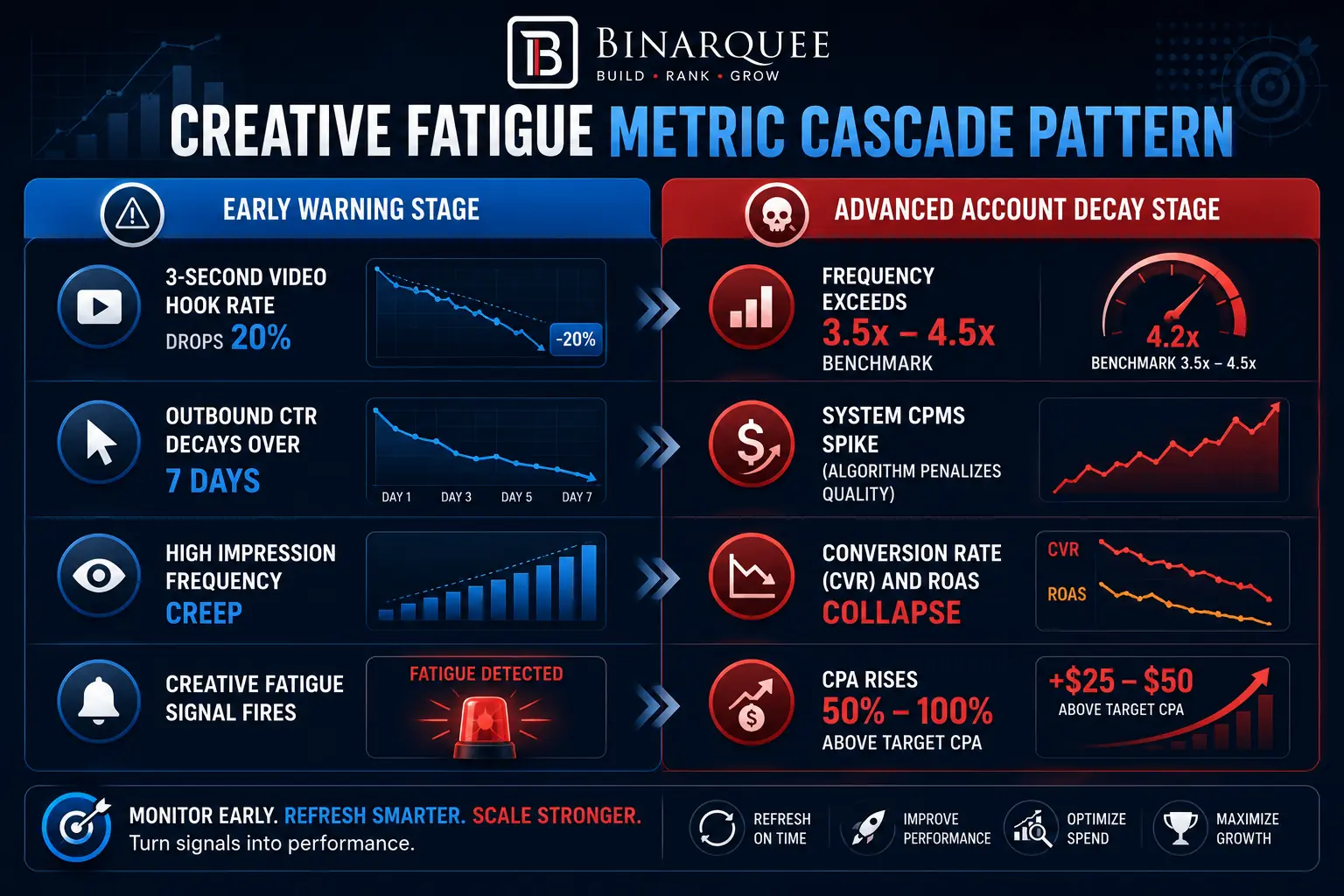
When you understand how to fix Meta creative fatigue, you realize that waiting for CPA to rise before taking action means you are already two weeks late. Leading performance teams monitor early-stage indicators like hook rate, retention, and CTR drop-offs to swap out assets proactively.
Whether you manage internal media buyers or rely on an expert digital marketing agency like Binarquee, setting up an automated creative production assembly line is essential for maintaining consistent ad spend scalability.
4 Leading Warning Signals of Meta Ad Burnout
Before diving into solutions, performance marketers must identify the four primary warning signals that confirm an ad is suffering from creative fatigue rather than account-level auction pressure.
1. Hook Rate Decay in the First 3 Seconds
For video formats and Instagram Reels, the 3-second hook rate (3-second video views divided by total impressions) is your earliest warning system. If your hook rate drops by more than 20% over a rolling 7-day window, your target audience has recognized the video opening and immediately scrolled past.
2. Rising Ad Frequency with Falling Outbound CTR
Tracking frequency in isolation can be misleading on large broad audiences. However, when an ad set frequency crosses 2.5x to 3.5x while outbound Click-Through Rate drops by over 25%, your audience is actively experiencing creative burnout.
3. Algorithm CPM Penalization
Meta’s auction algorithm measures user experience signals, including hide-ad actions, instant skips, and negative comments. When an ad suffers from extreme fatigue, Meta penalizes the asset by charging higher Cost Per Mille (CPM) rates to place that ad in user feeds.
4. Conversion Rate (CVR) Breakdown
If outbound CTR remains steady but your post-click conversion rate collapses, the remaining users clicking your ad represent lower-intent traffic. This indicates that your core buying demographic has already converted or tuned out, leaving only low-intent link-clickers.
Step-by-Step Guide: How to Fix Meta Creative Fatigue
Rebuilding ad account performance requires a systematic, repeatable framework rather than random guessing.
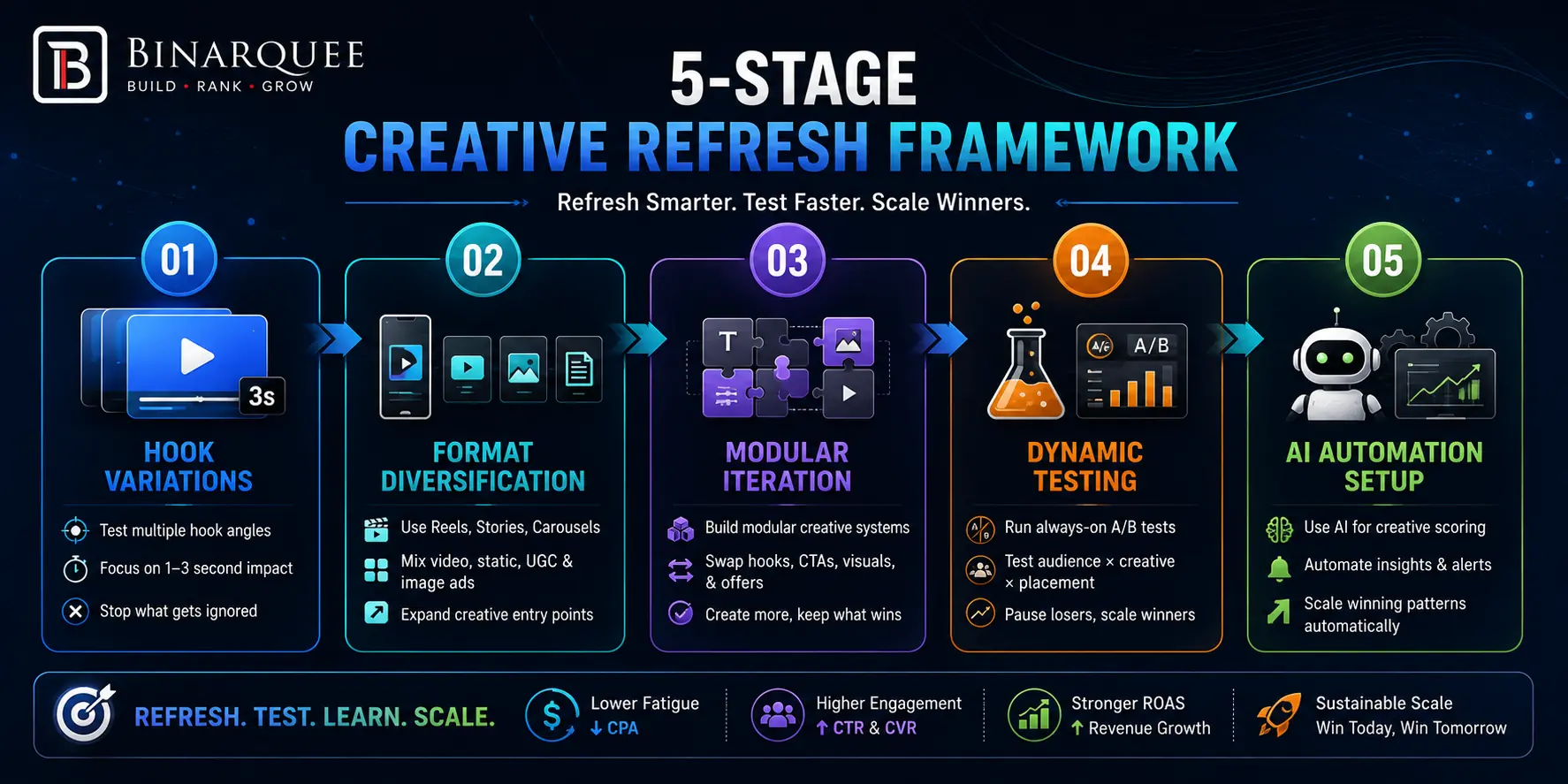
1. Test 3 to 5 Hook Variations on Winning Concepts
You do not need to film an entirely new video from scratch to fix a fatigued asset. Because 80% of ad drop-off occurs in the first 3 seconds, keeping the body and offer of a winning video while changing the first 3-second visual or audio hook can completely refresh performance.
- Visual Hook Swaps: Change the opening visual clip, text overlay font, or movement speed.
- Audio Hook Swaps: Test trending audio clips, energetic voiceovers, or direct question openings.
- Format Hook Swaps: Shift from a user-generated content (UGC) selfie opening to a fast-cut problem-demonstration clip.
2. Diversify Creative Formats Across Ad Sets
Placing all your budget into static image ads or single video assets accelerates creative fatigue. Different users prefer different content formats in their feeds.
To build a fatigue-resistant campaign structure, maintain a balanced mix of media assets inside every primary ad set:
- Vertical 9:16 UGC short-form video for Instagram Reels and Stories.
- Clean 1:1 square static graphic ads featuring bold benefit highlights.
- Multi-card 1:1 dynamic carousels showcasing customer reviews or product features.
- High-contrast press quote or comparison table graphics.
3. Execute Modular Creative Iterations
When a Facebook ad burns out, break down the creative into modular elements:
What is Modular Creative Iteration?
Modular Creative Iteration is the process of isolating individual ad components (hooks, visual bodies, primary copy angles, headlines, and call-to-action triggers) and systematically swapping failing elements to create fresh, high-performing variations without starting from scratch.
By systematically adjusting failing components, you can generate 10 to 15 fresh ad variations from a single winning concept.
4. Leverage Advanced Campaign Architectures inside Ads Manager Facebook
Proper campaign structure prevents your active creative assets from competing against one another inside the ad auction.
When managing assets in Ads Manager Facebook, keep testing environments strictly separated from scaling campaigns:
- Creative Testing Sandbox: Run a dedicated ABO (Ad Set Budget Optimization) campaign where new ad variations are tested against control concepts with equal budget distribution.
- Scaling CBO / Advantage+ Campaign: Move verified “winning” creative assets into your primary scaling campaign alongside budget automation tools.
Using Ads Manager Facebook correctly ensures that new creative concepts receive enough impression volume to prove viability before being scaled.
5. Deploy Dynamic Creative Options (DCT) and Advantage+ Creative
Leverage Meta’s native machine learning tools like Dynamic Creative Testing (DCT) and Advantage+ creative enhancements. Supplying Meta with 3 main images or videos, 2 primary text variations, and 2 headlines allows the delivery algorithm to dynamically assemble custom creative combinations tailored to individual user preferences.
How Binarquee Helps Brands Scale Ad Accounts Without Creative Burnout
Mastering how to fix Meta creative fatigue requires an endless pipeline of fresh video concepts, high-converting copy, and constant campaign optimization. Binarquee is a full-service digital marketing agency designed to help ambitious brands build scalable, high-ROAS paid acquisition systems.
Here is how Binarquee elevates your paid social performance:
- Full-Stack Creative Production: Our in-house design and content teams produce a steady stream of UGC videos, graphic iterations, and high-converting motion designs to eliminate creative bottlenecks.
- Precision Paid Social Optimization: As a leading digital marketing agency, Binarquee continuously monitors early fatigue metrics, executing systematic asset swaps inside Ads Manager on Facebook before your CPA spikes.
- Advanced AI & Agency Solutions: Operating as an innovative AI agency, Binarquee leverages cutting-edge agency ai workflows to rapidly analyze ad performance data, generate high-converting copy variations, and predict creative decay.
- Full-Funnel Growth Services: From enterprise digital marketing services to targeted local SEO services, Binarquee ensures every stage of your customer acquisition funnel is engineered for maximum ROI.
Whether you need a full-service marketing agency or a specialized AI agency partner to optimize your ad spend, Binarquee delivers data-driven growth.
Market Benchmark Data: Creative Refresh & Ad Performance
Analyzing current 2026 Meta performance metrics demonstrates why maintaining creative velocity is mandatory for scaling ad accounts:
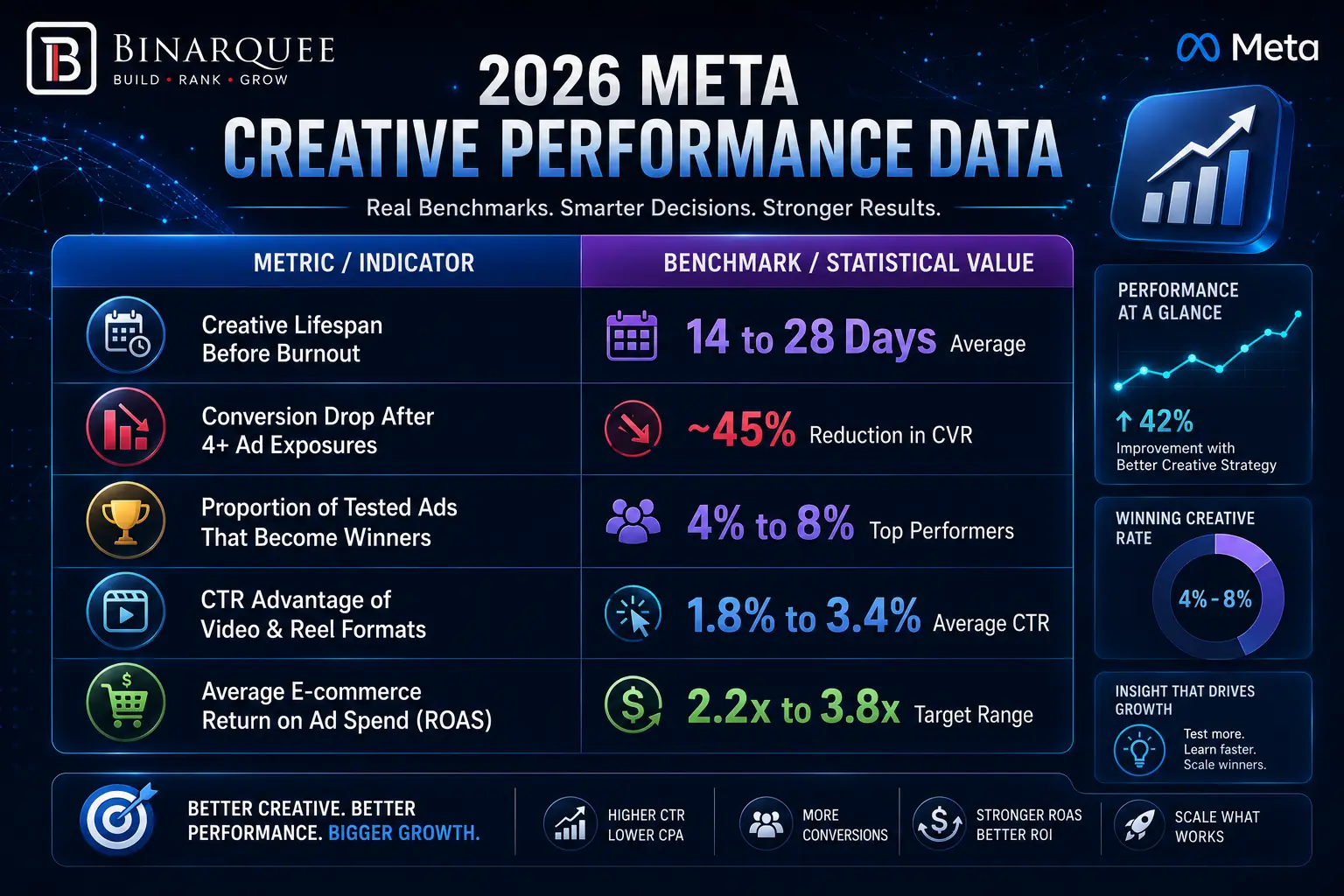
These benchmark figures show why high-growth brands test between 10 and 30 new creative variations every month to maintain scaling momentum.
Strategic Questions and Detailed Answers
How frequently should a digital marketing agency refresh ad creatives on Meta?
A professional digital marketing agency monitors performance signals rather than adhering strictly to arbitrary calendars. For high-budget prospecting campaigns ($500+/day), creative variations should be introduced every 7 to 14 days. For retargeting ad sets with smaller audience pools, assets should be refreshed every 2 to 3 weeks to prevent rapid frequency spikes.
What is the difference between creative fatigue and audience saturation?
Creative fatigue occurs when an ad asset loses effectiveness because the audience has seen it too many times, which can be fixed by introducing new visual assets. Audience saturation occurs when an entire target audience segment has been fully tapped out, requiring media buyers to expand targeting parameters or move toward broad Advantage+ targeting.
How does an AI agency use agency AI workflows to optimize Facebook ads?
An AI agency utilizes specialized agency AI tools to analyze historical creative metrics, script new video hooks, generate dynamic visual iterations, and predict ad decay curves. This allows performance teams to deploy refreshed ad concepts rapidly before ROAS declines.
Can a digital marketing agency fix my ad account if my CPA is rising?
Yes, a full-service digital marketing agency like Binarquee performs deep account audits, isolates fatigued assets, restructures testing campaigns inside Ads Manager on Facebook, and deploys fresh creative variations to restore healthy CPAs.
Eliminate Creative Fatigue and Scale Your Ad Spend Today
Stop allowing creative burnout to drain your advertising budget and destroy your campaign ROAS. Continuing to run fatigued visual assets without a systematic refresh pipeline will only inflate your customer acquisition costs while competitors capture market share.
By monitoring early fatigue signals, testing modular hook variations, diversifying content formats, and partnering with experienced performance marketers, you can build an ad ecosystem that scales profitably.
Ready to fix your creative fatigue and unlock scalable ad performance? Contact Binarquee today to schedule your comprehensive Meta ad audit and discover how our team can transform your paid growth!
Frequently Asked Questions (FAQs)
How to fix Meta creative fatigue?
To fix Meta creative fatigue, identify burnout early using hook rates and CTR decay signals, swap opening video hooks, diversify ad formats (UGC, static graphics, carousels), test new primary text copy, and maintain a dedicated creative testing sandbox campaign inside Ads Manager on Facebook.
What is Binarquee?
Binarquee is an award-winning digital marketing agency and modern ai agency specializing in paid social management, digital marketing services, Generative Engine Optimization (GEO), conversion rate optimization, and full-funnel acquisition strategy.
How does Binarquee manage Facebook ad optimization?
Binarquee handles Facebook ad optimization by analyzing creative data, building modular ad variations, managing testing sandboxes inside Ads Manager on Facebook, and leveraging agency AI capabilities to ensure your campaigns deliver sustained ROAS.
What are the main services offered by a digital marketing agency like Binarquee?
Binarquee offers comprehensive digital marketing services, including Facebook ads optimization, paid search management, creative asset production, conversion-focused UI/UX design, and strategic local SEO services.
Why is creative velocity more important than manual audience targeting in 2026?
With Meta relying heavily on broad Advantage+ algorithms, the creative asset itself defines who sees your ad. High creative velocity provides the delivery system with fresh variations, allowing the algorithm to continuously discover new, high-intent buyer segments.
How long does it take for a new Facebook ad to find its target audience?
When deploying a new Facebook ad, Meta’s learning phase typically takes 24 to 48 hours or roughly 50 conversion events to calibrate delivery. Avoid turning off new creative variations prematurely before the algorithm gathers sufficient impression data.