
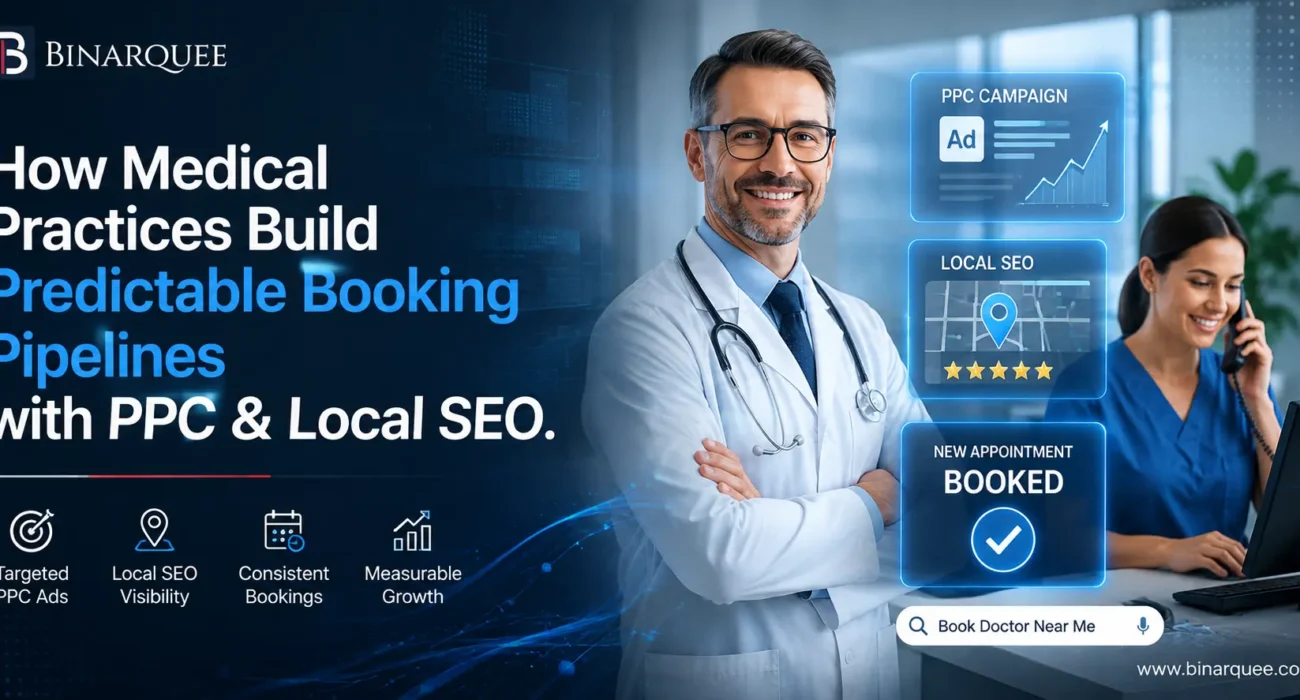
Learning how medical practices build predictable booking pipelines with PPC & local SEO is the single most critical capability for practice managers, clinical directors, and healthcare growth leads trying to fill daily appointment books. Relying on passive word-of-mouth referrals or physical billboards creates volatile revenue cycles. One month your waiting room is packed; the next, your front desk staff is struggling to fill empty appointment slots.
Modern patient discovery has shifted permanently to digital channels. Industry benchmark data shows that over 82% of healthcare ad spend is now digital, with Google handling billions of health-related queries every single year. Furthermore, Google Business Profile local search alone drives nearly 30% of all healthcare leads, making local map placements the largest single patient acquisition channel.
When a prospective patient experiences symptoms, requires specialized care, or seeks a nearby clinic, they turn to search engine results. If your clinic does not occupy top placement in local search maps and paid search results, patients simply schedule appointments with competing practices down the street.
By deploying a hybrid patient acquisition framework combining fast-acting Pay-Per-Click (PPC) ads with long-term Local Search Engine Optimization (SEO), your clinic can generate a steady, predictable flow of qualified patient bookings. Here is your ultimate, data-backed guide detailing how medical practices build predictable booking pipelines with PPC & local SEO.
The Hybrid Growth Model: Speed Meets Sustainable Equity
To understand how medical practices build predictable booking pipelines with PPC & local SEO, you must recognize that paid ads and organic local search perform two distinct, complementary functions.
PPC search ads operate like a faucet. The moment your campaign goes live, your clinic appears at the very top of Google for high-intent search terms. This provides immediate patient bookings for high-margin treatments and specialized procedure lines. Local SEO, on the other hand, builds compounding digital equity. Optimizing your Google Business Profile, local directory citations, and site architecture earns organic map pack rankings that deliver low-cost leads for years.
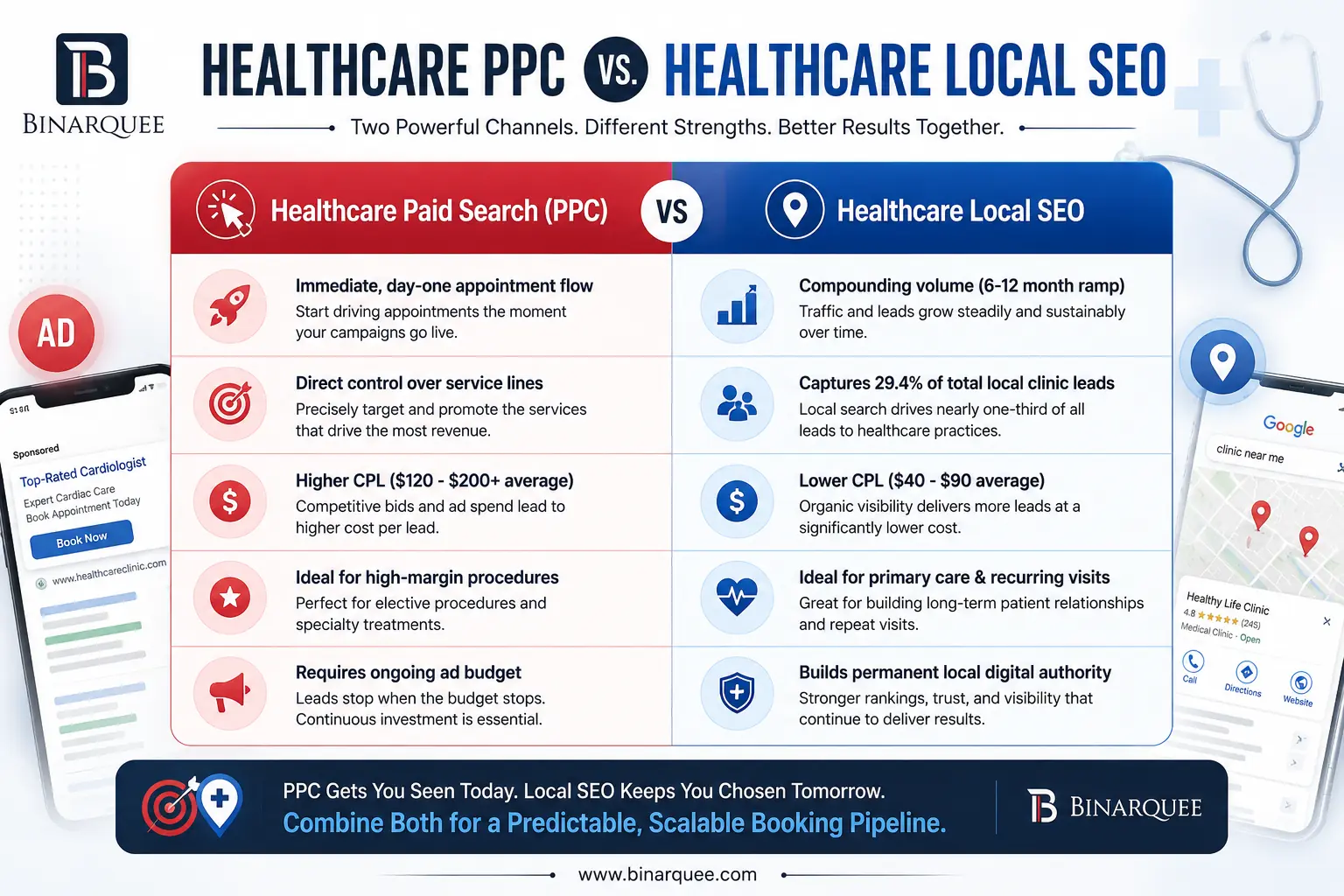
When you combine both channels, PPC captures immediate patient intent while local SEO lowers your overall average Cost Per Acquisition (CPA) over time.
Navigating medical keyword bidding, HIPAA-conscious tracking regulations, and local map algorithms requires specialized execution. Partnering with a premier digital marketing agency like Binarquee ensures your practice builds compliant, high-converting patient acquisition engines.
5 Core Pillars: How Medical Practices Build Predictable Booking Pipelines with PPC & Local SEO
Building a predictable patient acquisition system requires executing five distinct operational and technical frameworks.
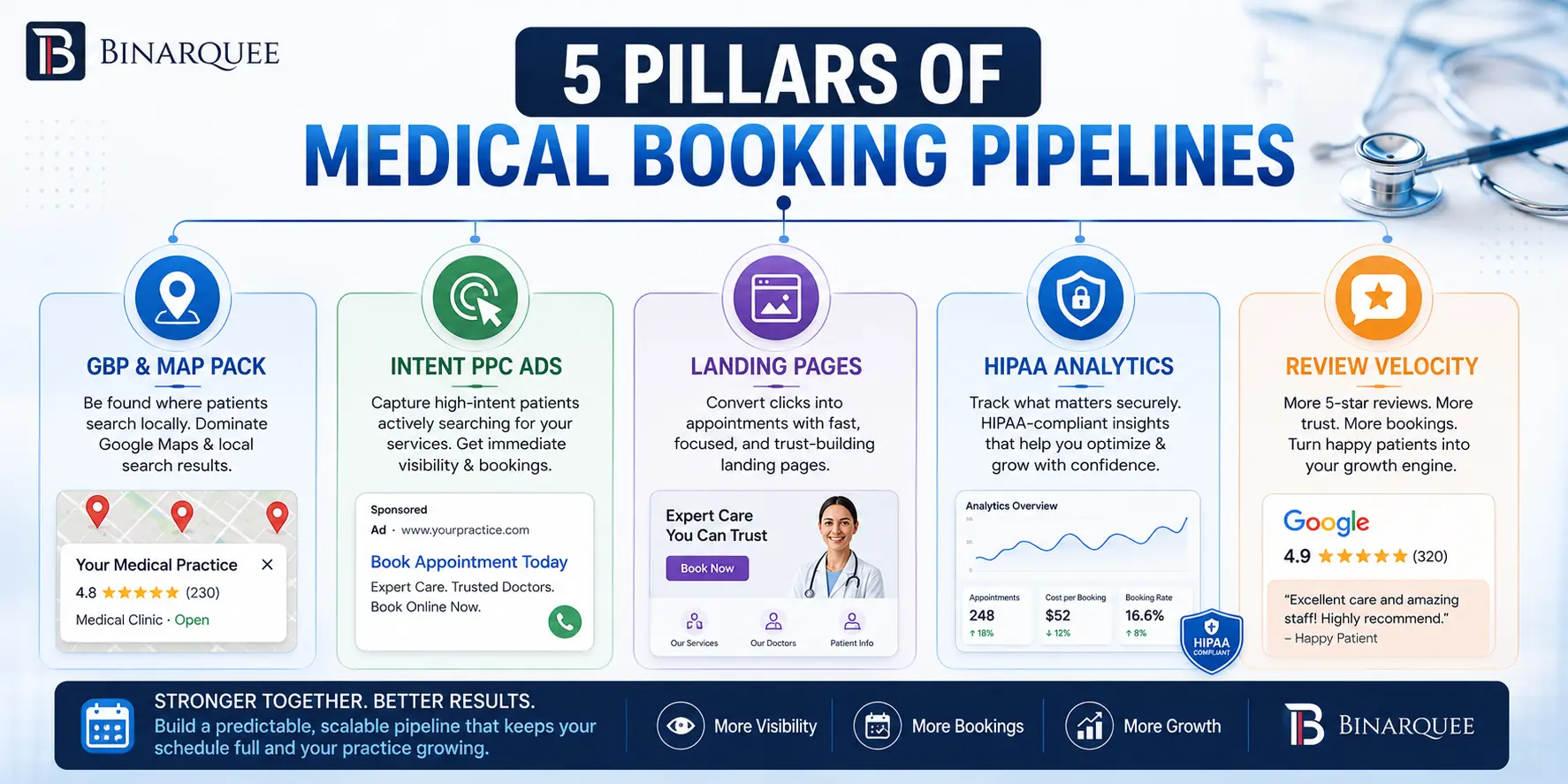
1. Optimize Google Business Profile for Map Pack Domination
Over 76% of local healthcare searches result in a phone call, direction request, or direct booking within 24 hours. Google’s local 3-Pack occupies premium real estate on mobile screens, capturing between 25% and 35% of all user clicks for local queries.
To dominate local map packs:
- Maintain 100% Name, Address, and Phone (NAP) consistency across all medical directories. Practices with verified, consistent citation data are 40% more likely to reach top map pack placements.
- Select precise primary and secondary medical categories (for example, Urgent Care Clinic vs. Medical Clinic).
- Publish regular Google updates highlighting clinic hours, insurance accepted, new doctors, and preventive health tips.
2. Launch Precision High-Intent PPC Campaigns
When prospective patients search for “dermatologist near me appointment” or “urgent care open now,” they want immediate care. Bidding on these commercial, high-intent phrases ensures your clinic appears above all organic listings.
Effective digital marketing for healthcare campaigns uses exact match and tight phrase match keyword clusters to prevent wasted ad spend. Implementing strict negative keyword lists (excluding words like “salary,” “jobs,” or “free advice”) keeps your daily ad budget focused strictly on active patients.
3. Build High-Converting, Friction-Free Patient Landing Pages
Directing paid traffic to a generic clinic homepage kills conversion rates. High-performing medical marketing relies on dedicated, service-specific landing pages that answer patient concerns instantly.
Essential medical landing page elements include:
- Clear Call-to-Action Buttons: Prominent “Book Online” and tap-to-call phone buttons visible without scrolling.
- Provider Credentials: Doctor bios, board certifications, and verified patient ratings to establish immediate E-E-A-T trust.
- Insurance Verification: Clear lists of accepted insurance providers to reduce booking hesitation.
- Fast Mobile Performance: Mobile load speeds under 2 seconds to prevent anxious patients from bouncing off the page.
What is Conversion Rate Optimization (CRO) for Medical Practices?
Conversion Rate Optimization (CRO) for medical practices is the strategic process of refining landing page layouts, booking forms, page load speeds, and trust badges to maximize the percentage of web visitors who book a real clinical appointment.
4. Maintain Patient Data Privacy and Server-Side Analytics
Modern digital marketing for healthcare industry operations must comply with strict HIPAA enforcement and state privacy mandates. Standard tracking pixels (like standard Meta or Google pixels) installed directly on medical booking forms risk transmitting protected health information (PHI).
Leading practices deploy server-side tracking and consent-managed analytics. Server-side tracking strips sensitive patient data before sending anonymized conversion signals back to Google Ads. This allows campaign algorithms to optimize for actual booked consultations while maintaining 100% regulatory compliance.
5. Drive Automated Review Velocity and Sentiment
Online reviews serve as the new digital word-of-mouth. Over 74% of consumers view reviews as essential when choosing a new doctor, and clinics with over 50 verified Google reviews earn 71% more profile clicks.
Implementing automated SMS post-appointment review workflows encourages satisfied patients to leave positive feedback, directly boosting local SEO map pack rankings and PPC ad click-through rates.
Market Statistics: Healthcare Search & Local SEO Data
Analyzing current market data highlights why investing in integrated search strategies is essential for clinic growth:
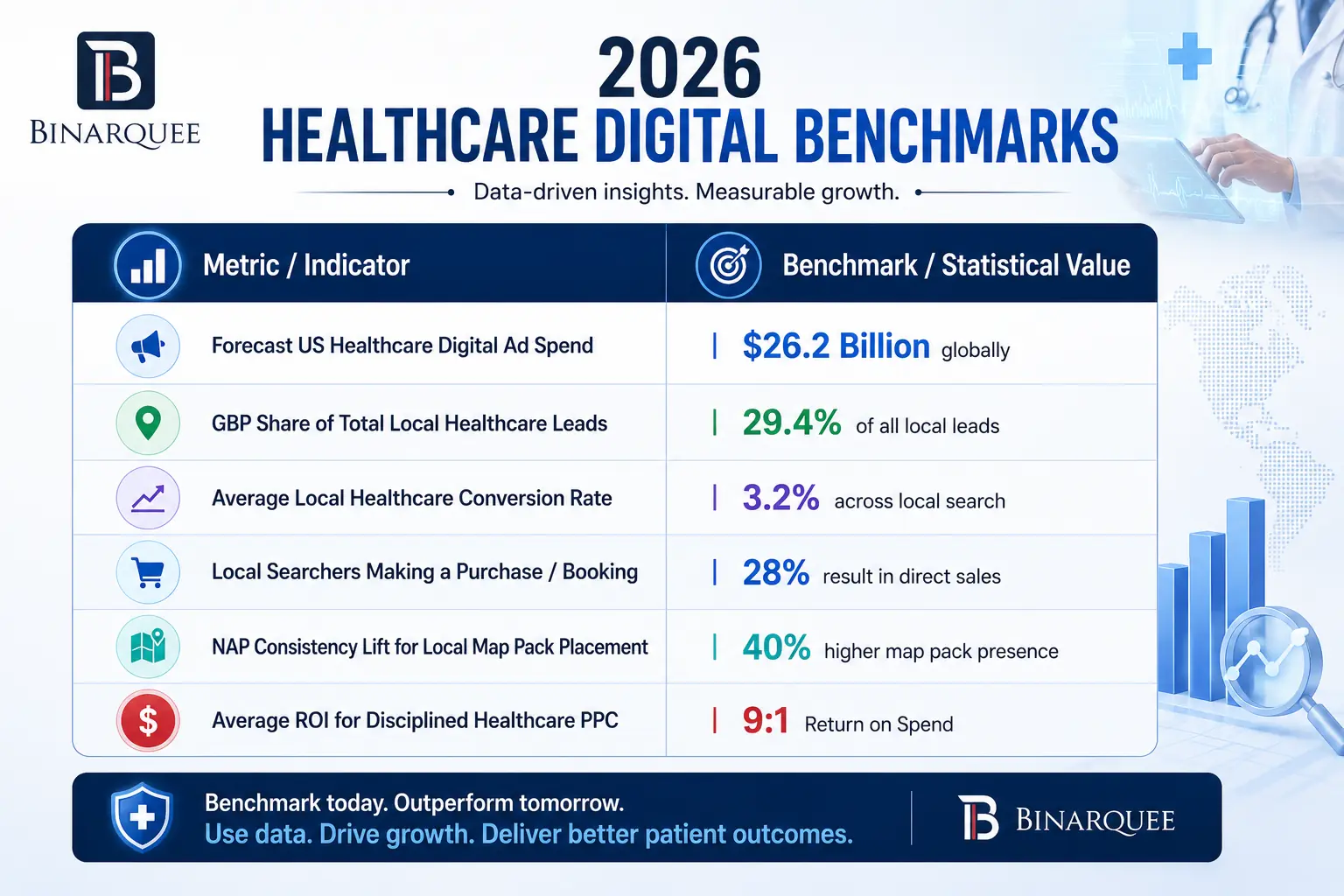
These benchmark figures show that combining paid search speed with local SEO visibility creates an unbeatable market advantage.
Strategic Questions and Deep-Dive Answers
How does digital marketing in healthcare differ from standard retail marketing?
Executing digital marketing in healthcare requires strict compliance with HIPAA privacy standards, state data privacy frameworks, and Google’s YMYL (Your Money Your Life) content rules. Medical campaigns must focus heavily on trust, physician credentials, clear medical disclosures, and server-side tracking to protect patient data while driving pipeline growth.
Why should specialized clinics work with a digital marketing agency for hospitals or medical practices?
Partnering with a specialized digital marketing agency for hospitals or medical groups ensures campaign structures, ad copy, and landing pages adhere to medical advertising regulations. An experienced digital marketing agency understands patient search intent, medical keyword nuances, and privacy-safe attribution models.
What is the role of an AI agency or agency AI framework in hospital digital marketing?
An innovative AI agency uses specialized agency AI tools to analyze search query trends, automate bid adjustments for high-intent keywords, and build predictive audience models. This allows digital marketing for hospitals to lower cost-per-lead rates while improving appointment show rates.
How long does it take to see results from digital marketing for hospitals?
Paid search campaigns delivered via hospital digital marketing generate immediate appointment bookings on day one. Local SEO map pack optimizations typically build compounding traffic volume over 3 to 6 months.
How Binarquee Helps Medical Practices Build Predictable Booking Pipelines
Understanding how medical practices build predictable booking pipelines with PPC & local SEO requires deep technical marketing skills, regulatory knowledge, and landing page engineering. Binarquee is a premier digital marketing agency and cutting-edge ai agency designed to help healthcare organizations scale patient appointments predictably.
Here is how Binarquee transforms your practice’s patient acquisition:
- Integrated PPC & Local SEO Strategy: As a leading agency for digital marketing in healthcare, we build unified search ecosystems combining high-ROI Google Ads with local map pack optimization.
- HIPAA-Conscious Privacy Infrastructure: Operating as an advanced AI agency, Binarquee implements server-side tracking and privacy-safe agency AI pipelines to track phone calls and form bookings without violating patient privacy.
- High-Converting Medical Landing Pages: We design fast, mobile-first landing pages tailored to specific medical service lines, maximizing appointment booking conversions.
- Local Map Pack & Review Velocity Systems: We manage your Google Business Profile, enforce NAP consistency across medical directories, and deploy automated review requests to dominate local search maps.
- Specialized Enterprise Solutions: From multi-location clinics to digital marketing for healthcare industry groups, Binarquee provides comprehensive hospital digital marketing, digital marketing for healthcare, and digital marketing for hospitals strategies that drive measurable revenue growth.
Partnering with Binarquee transforms your clinic’s patient marketing from an unpredictable cost center into a reliable, high-margin revenue engine.
Step-by-Step Blueprint: Deploying Your Patient Booking Engine
Follow this 5-step operational framework to build a predictable booking pipeline for your medical practice.
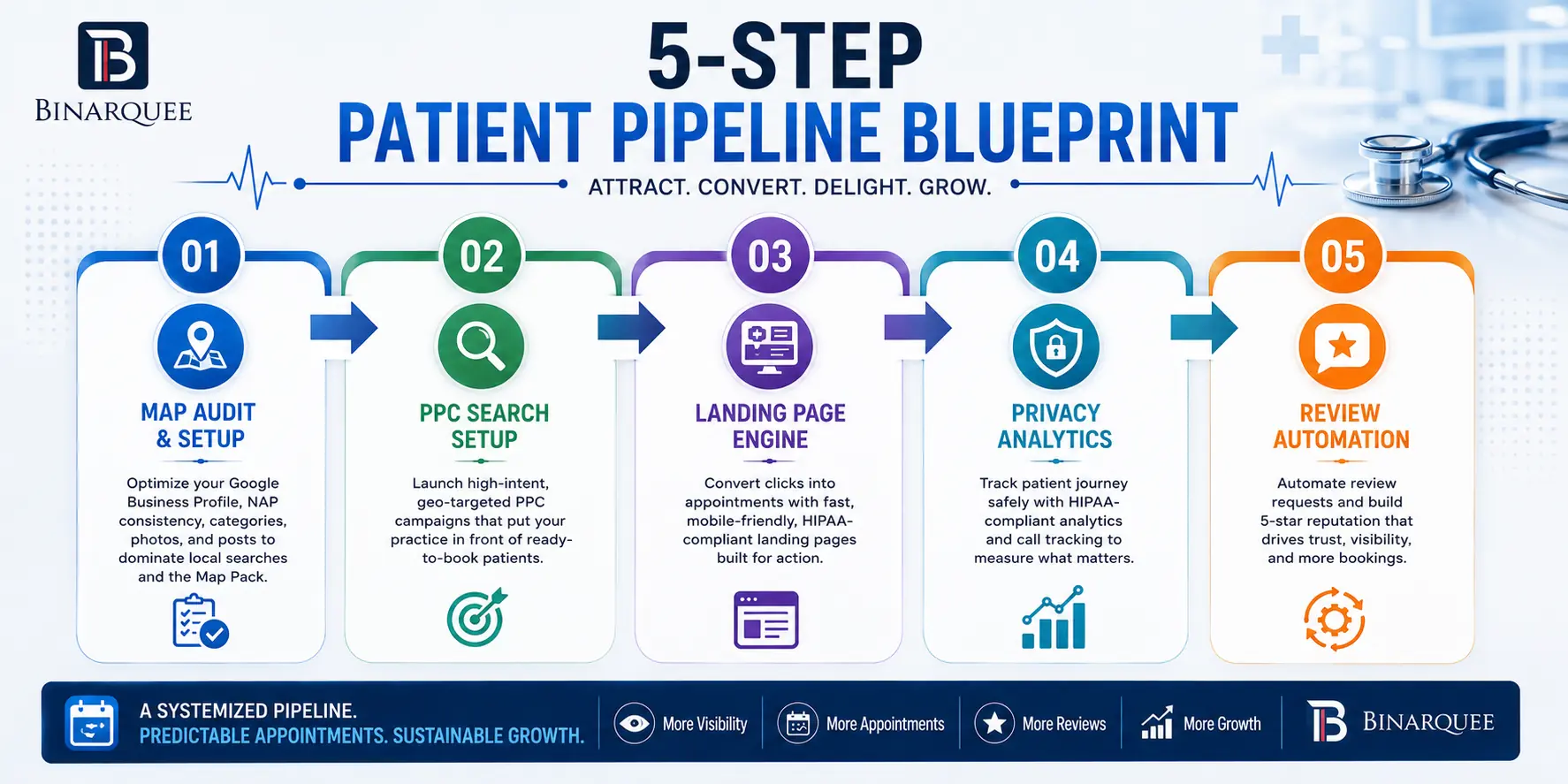
Step 1: Audit Local Map Listings and Directory NAP Consistency
Audit your clinic’s Google Business Profile alongside major medical directories (Healthgrades, Vitals, WebMD). Correct any conflicting phone numbers, outdated addresses, or missing category tags to ensure maximum map pack visibility.
Step 2: Build High-Intent PPC Search Campaigns
Structure Google Ads campaigns by specific treatment lines (e.g., Orthopedic Knee Surgery vs. General Physical Therapy). Use exact-match keywords paired with localized geographic radius targeting to show ads only to nearby patients.
Step 3: Deploy Service-Specific Landing Pages
Replace generic homepage ad links with custom, fast-loading service landing pages. Ensure every page includes clear doctor qualifications, accepted insurance options, and one-tap online scheduling tools.
Step 4: Implement Privacy-Safe Server-Side Analytics
Work with a qualified digital marketing agency for hospitals to install server-side tracking containers. This ensures conversion data feeds accurately into Google Ads algorithms while remaining fully compliant with HIPAA regulations.
Step 5: Partner with an Expert Digital Marketing Agency
Collaborating with a dedicated healthcare growth partner ensures your paid ad budgets, local map listings, review workflows, and landing page conversions are continuously optimized for maximum practice profitability.
Build Your Predictable Patient Booking Engine Today
Relying on unpredictable word-of-mouth referrals while leaving your digital presence unoptimized guarantees empty appointment slots and volatile clinic revenue.
By mastering how medical practices build predictable booking pipelines with PPC & local SEO, deploying privacy-safe ad campaigns, optimizing your Google Business Profile, and building fast landing pages, you can fill your appointment books weeks in advance.
Ready to eliminate empty calendar slots and build a high-growth patient pipeline? Contact Binarquee today to schedule your custom healthcare growth session and discover how our team can scale your practice appointments!
Frequently Asked Questions (FAQs)
How do medical practices build predictable booking pipelines with PPC & local SEO?
Medical practices build predictable booking pipelines by using high-intent PPC search ads to capture immediate appointment demand while simultaneously optimizing their Google Business Profile and local directory listings to secure long-term, low-cost organic map pack traffic.
What is Binarquee?
Binarquee is a premier digital marketing agency and AI agency specializing in digital marketing for healthcare, digital marketing for hospitals, Generative Engine Optimization, and conversion rate optimization for medical practices.
Why is local SEO critical for digital marketing in healthcare?
Local SEO is critical because 29.4% of all local healthcare leads originate directly from Google Business Profile map listings. Patients seeking local care prefer clinics that appear at the top of local maps with strong star ratings and verified patient reviews.
How does Binarquee help with digital marketing for healthcare industry practices?
Binarquee builds compliant healthcare marketing systems, combining privacy-safe Google Ads, Google Business Profile optimization, fast landing pages, and automated reviews to drive predictable patient appointments.
What is the average Cost Per Lead (CPL) for medical PPC compared to local SEO?
While healthcare PPC ads average $120 to $200+ per lead depending on medical specialty competition, organic local SEO delivers leads at an average of $40 to $90 with higher consultation close rates.
How long does it take to scale a clinic’s appointment volume using hospital digital marketing?
PPC campaigns drive immediate patient phone calls and bookings on day one. Local SEO map pack rankings build significant, compounding lead volume over 3 to 6 months.