
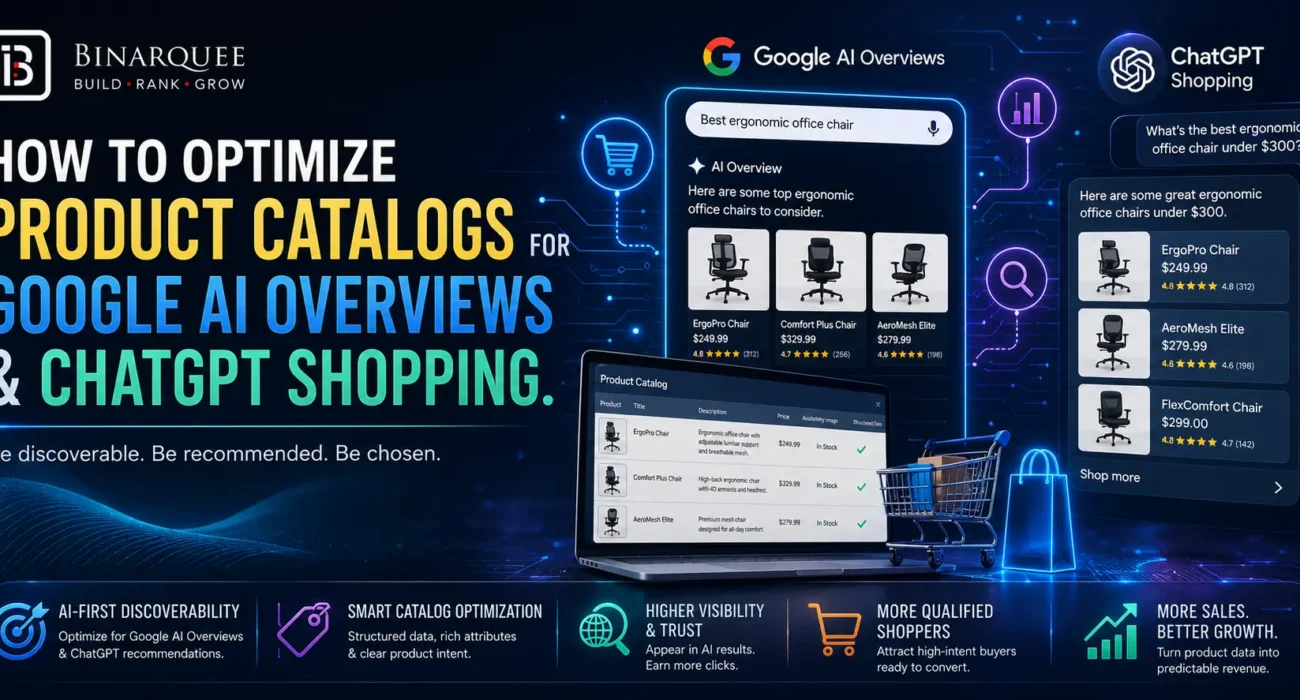
Learning how to optimize product catalogs for Google AI Overviews & ChatGPT shopping is the primary growth catalyst for retail brands navigating the next generation of generative search. When online shoppers look for products today, they no longer scan twenty blue links or click blindly through generic category pages. Instead, prospective buyers use conversational prompts like “find lightweight waterproof hiking boots for wide feet under $150 with good arch support” inside Google AI Overviews, ChatGPT Search, and Perplexity.
According to 2026 digital commerce benchmark data, Google’s Shopping Graph now indexes more than 60 billion product listings, refreshing over 2 billion items every single hour. Furthermore, AI Overviews appear across roughly 14% of high-intent shopping queries, representing a 5.6-fold increase over previous quarters. When Large Language Models evaluate product catalogs, they do not just match keywords; they evaluate structured attributes, real-time inventory feeds, third-party sentiment, and verified schema markup.
If your ecommerce catalog lacks machine-readable data, conversational AI assistants will recommend your competitors. Partnering with a specialized digital marketing agency allows online retailers to bridge the technical gap between traditional search optimization and agentic shopping discovery. Here is your definitive masterclass on how to optimize product catalogs for Google AI Overviews & ChatGPT shopping to dominate AI-driven retail.
The Technical Reality: How Google Shopping Graph and ChatGPT Process Catalogs
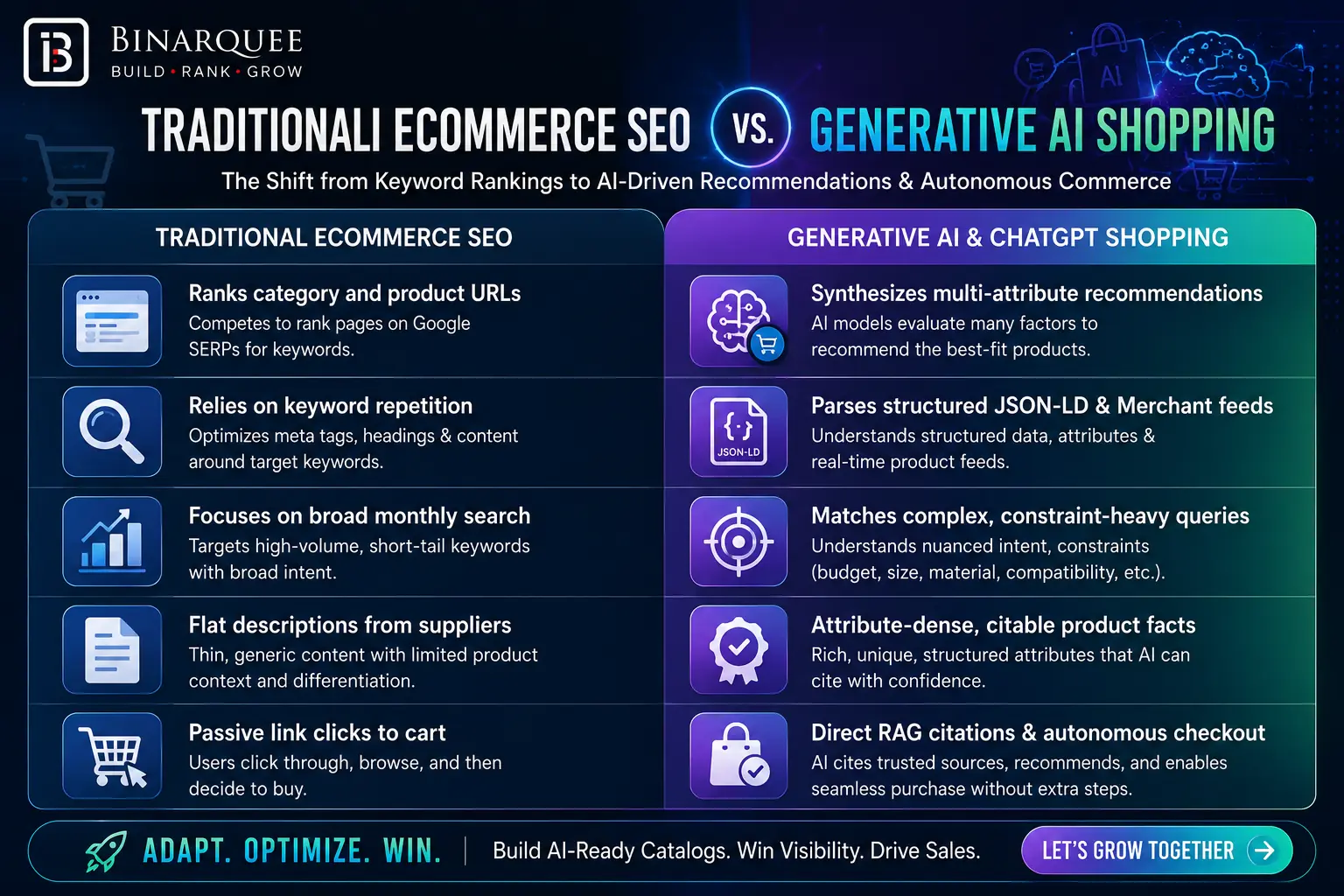
To capture visibility inside generative shopping summaries, you must understand the underlying retrieval mechanics. Traditional search engines crawl HTML pages looking for keywords in titles, headers, and meta tags. Generative shopping systems operate via Retrieval-Augmented Generation (RAG) coupled with real-time merchant APIs.
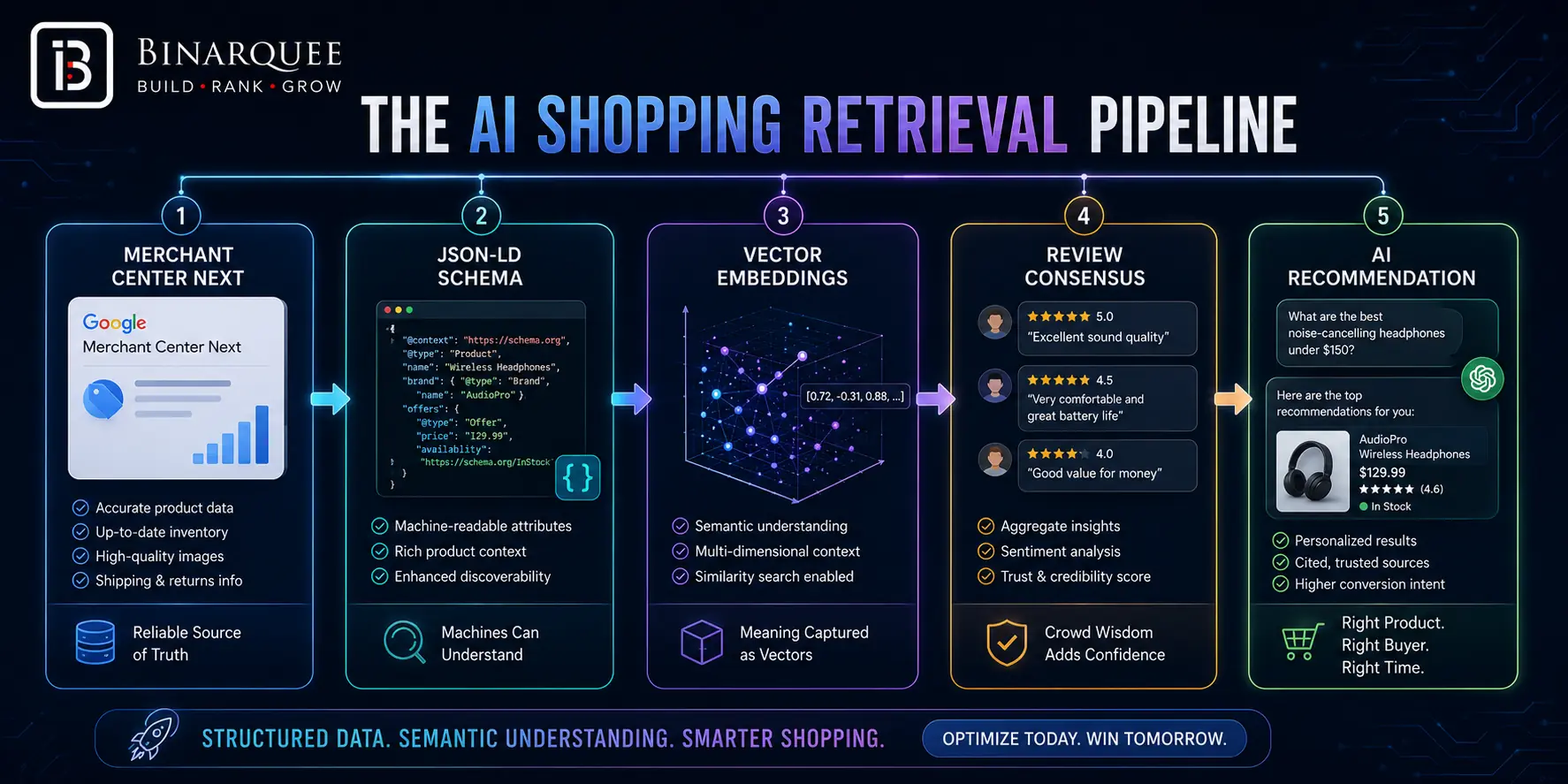
Google deploys dedicated crawlers, such as StoreBot, alongside Googlebot to parse merchant feeds, price updates, shipping rates, and structured product data. Simultaneously, OpenAI’s search engine crawls public web pages, product review roundups, and structured open web data to generate recommendations.
When these AI platforms analyze your inventory, they convert your product attributes into multidimensional vector embeddings. If your product page clearly defines materials, dimensions, specific use cases, and compatibility details, the AI algorithm scores your listing with high relevance.
Executing this level of precision requires working with an experienced ecommerce agency that understands semantic data architecture. When brands invest in modern e commerce marketing, structuring catalog data for both human buyers and AI shopping engines becomes the top priority.
5 Core Pillars: How to Optimize Product Catalogs for Google AI Overviews & ChatGPT Shopping
Optimizing an online catalog for conversational AI engines requires a structured, multi-layer approach across data feeds, schema, and page content.
1. Enrich Feed Attributes in Google Merchant Center Next
Your Google Merchant Center feed is the direct highway to Google’s Shopping Graph. Submitting bare-minimum attributes (such as just title, price, and image link) guarantees that AI Overviews will overlook your items for complex queries.
High-growth brands optimize their product feeds with comprehensive attributes:
- Detailed Product Titles: Front-load brand, gender, material, size, color, and primary feature (for example: Brand Name Men’s Waterproof Trail Runner – Breathable Vibram Sole – Size 10.5). Restructuring titles in this manner lifts impression share by 15% to 30% without raising ad bids.
- Granular Attribute Tags: Populate fields for pattern, material, age_group, gender, size_system, energy_efficiency_class, and sustainability_standard.
- Product Highlights and Details: Use the product_highlight and product_detail attributes to feed bulleted specifications directly into the merchant database.
2. Implement Deep JSON-LD Product and Offer Schema
Structured schema markup acts as a universal translator for AI bots. When search crawlers visit your product pages, nested JSON-LD structured data removes all ambiguity regarding price, stock levels, and variants.
Essential schema components include:
- Product: Identifies the item, MPN, GTIN-13/UPC, brand entity, and high-resolution image URLs.
- Offer: Defines price currency, exact price, price valid until date, availability status (InStock, OutOfStock), and shipping details.
- AggregateRating & Review: Provides verified review scores and individual customer commentary.
- MerchantListing: Unlocks rich product snippet displays across Google AI search results.
What is Constraint-Based Product Optimization for AI Shopping?
Constraint-Based Product Optimization is the practice of embedding specific functional capabilities, environmental constraints, compatibility factors, and sizing realities into product descriptions and schema so AI assistants can accurately answer complex customer prompts.
Instead of writing vague marketing copy like “the best jacket ever,” write factual copy such as “designed for sub-zero conditions down to -10 degrees Celsius, featuring 800-fill goose down insulation and a helmet-compatible hood.”
3. Mine Customer Reviews to Build Answer-First Product FAQs
When consumers query ChatGPT or Google AI Overviews, they ask nuanced, real-world questions (such as “does this espresso machine fit under standard 18-inch kitchen cabinets?” or “is this moisturizer safe for rosacea-prone skin?”).
Leading teams mine their historical customer support tickets and review sections to identify recurring questions. Transforming these questions into direct 25-to-40-word answer blocks formatted with FAQPage schema ensures generative bots extract your answers directly into search summaries.
4. Build Multi-Platform Brand Consensus
AI search assistants do not rely solely on your website; they evaluate external validation. ChatGPT and Perplexity analyze third-party editorial reviews, Reddit discussions, YouTube gear roundups, and industry buying guides to verify whether your product is genuine.
Cultivating authentic digital PR, unboxing videos, and verified marketplace reviews signals to LLMs that your brand represents a trusted entity in its product category.
5. Deploy Full-Funnel Digital Marketing Services with Binarquee
Integrating product catalog feeds with paid search ads, organic SEO, and conversion-focused UI/UX design requires specialized execution. Working with a dedicated e commerce marketing agency ensures your store captures traffic across every phase of the modern buyer journey.
Market Statistics: The Rise of AI-Driven Digital Commerce
Analyzing 2026 global commerce trends underscores why optimizing your catalog for AI discovery is mandatory for revenue growth:
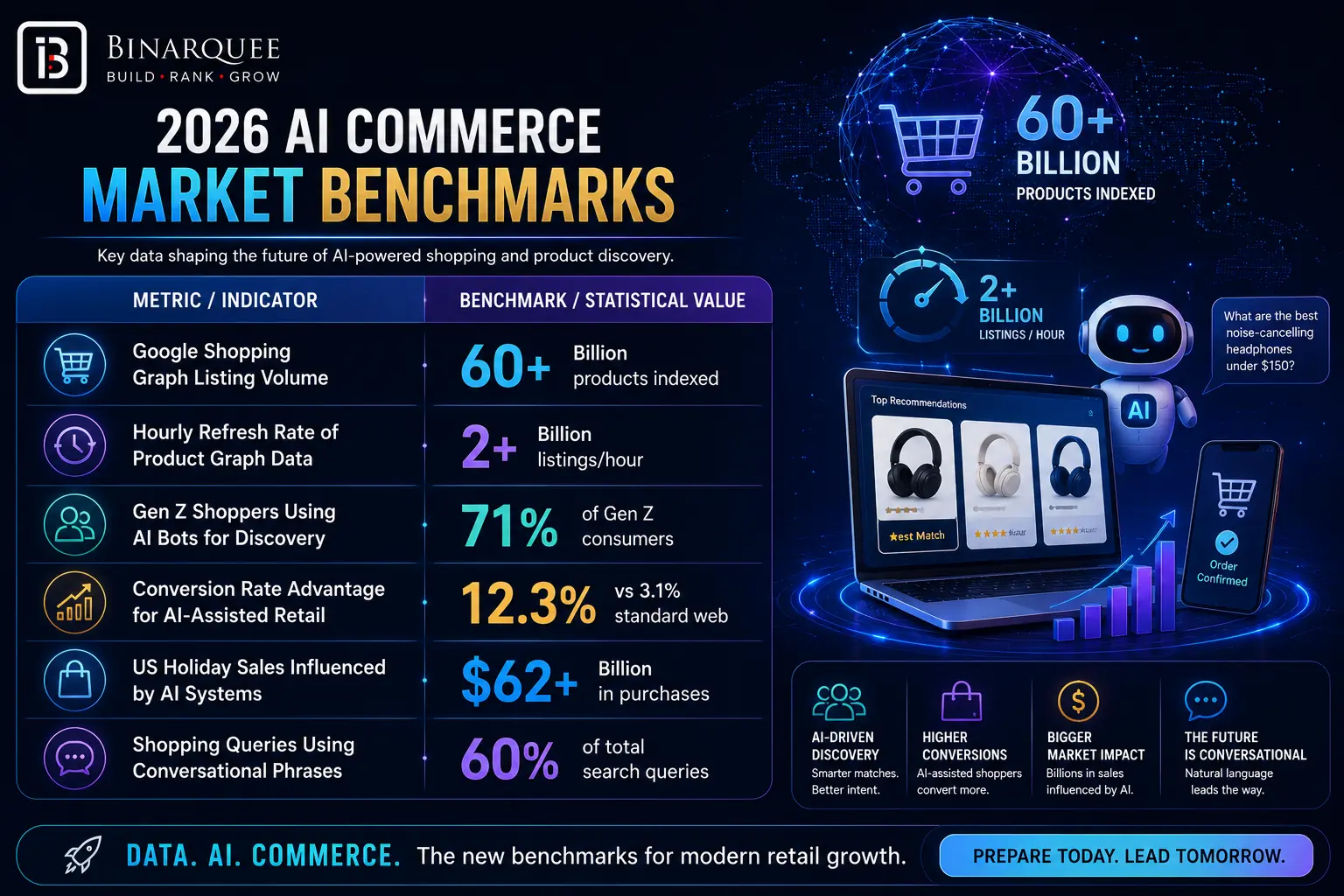
These numbers prove that conversational search is no longer a future concept; it is the current operating standard of modern retail.
Strategic Questions on Ecommerce and Marketing
How does marketing in ecommerce change with the arrival of ChatGPT Shopping?
Traditional marketing in ecommerce focused on bidding on exact-match keywords and building backlink volume. With ChatGPT Shopping and Google AI Overviews, ecommerce and marketing strategies must focus on structured product data feeds, entity clarity, real-time inventory synchronization, and authoritative third-party reviews that AI agents can verify.
Why should retailers partner with a specialized ecommerce agency?
A professional ecommerce agency handles the complex technical integrations required for modern retail. They optimize Google Merchant Center Next feeds, implement advanced JSON-LD schema, design fast mobile product pages, and build multichannel ad campaigns that maximize return on ad spend (ROAS).
How does an AI agency or agency AI framework enhance product feed optimization?
An AI agency uses advanced agency AI pipelines to analyze search query vectors, automate attribute tagging across thousands of SKUs, predict stock demand, and continuously test product titles for maximum impression share.
Can a digital marketing agency help small online stores rank in AI Overviews?
Yes, a full-service digital marketing agency audits your store’s crawlability, cleans up structured data, fixes merchant feed errors, and implements answer-first content that allows independent stores to compete with retail giants in AI search results.
How Binarquee Powers Product Catalog Optimization for Generative AI
Mastering how to optimize product catalogs for Google AI Overviews & ChatGPT shopping requires deep technical expertise, data engineering, and agile content production. Binarquee is a premier digital marketing agency, modern AI agency, and full-service ecommerce agency built to help ambitious brands scale digital sales across next-generation search engines.
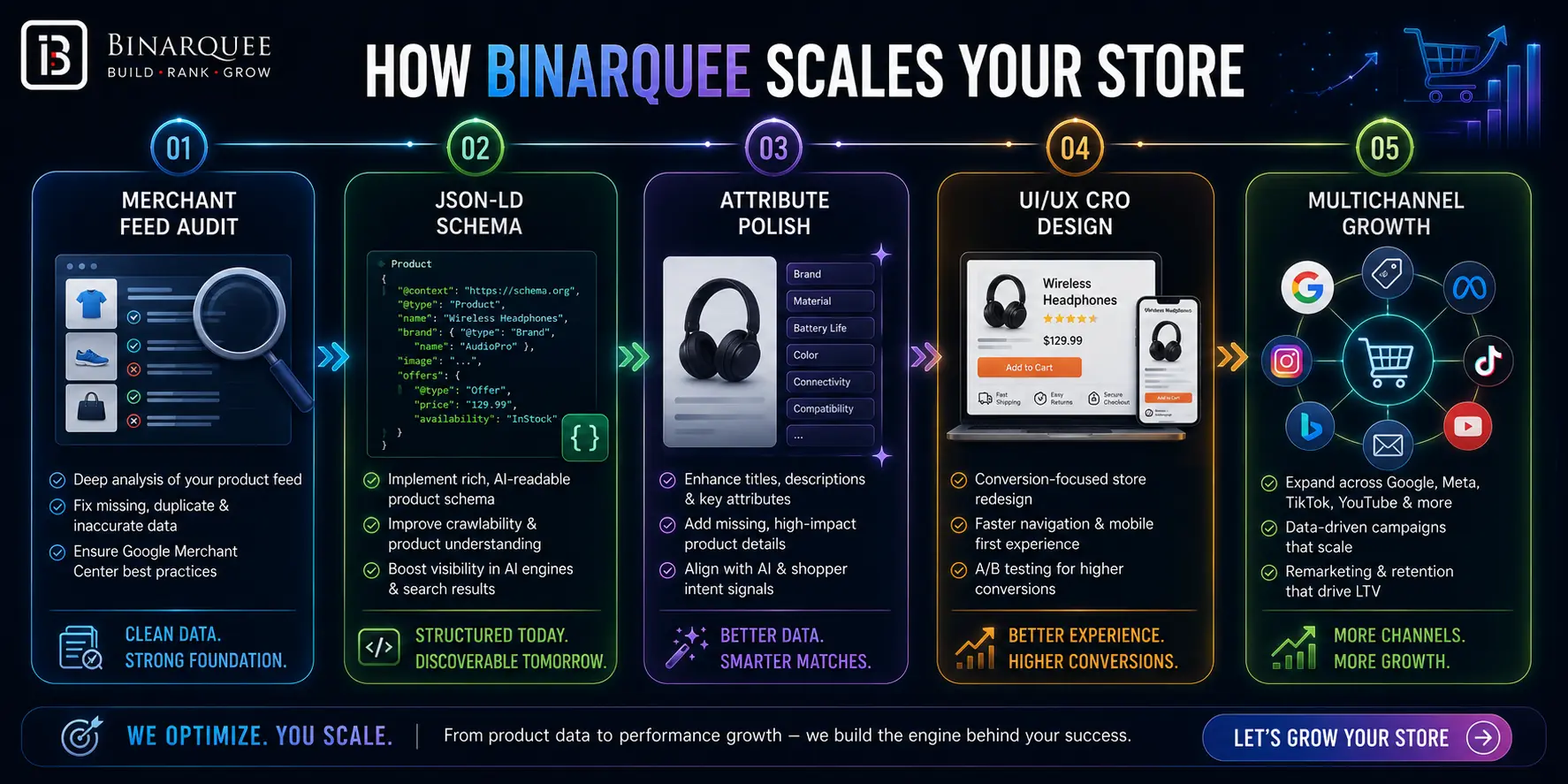
Here is how Binarquee elevates your online store:
- Comprehensive Merchant Feed Architecture: We audit, clean, and enrich your product feeds across Google Merchant Center Next and Bing Shopping, ensuring every attribute matches AI indexing requirements.
- Advanced JSON-LD Structured Data Engineering: Our technical developers deploy nested Product, Offer, AggregateRating, and MerchantListing schema markup across your catalog.
- Conversational Content & Attribute Optimization: As a specialized e commerce agency, we rewrite product titles, feature lists, and constraint-based FAQs to maximize extraction rates in Google AI Overviews and ChatGPT.
- Proprietary Agency AI Workflows: Operating as an innovative AI agency, Binarquee leverages cutting-edge agency AI tools to analyze search query intent, monitor AI citation share, and scale high-converting e commerce marketing campaigns.
- Full-Funnel Digital Marketing Services: From conversion rate optimization (CRO) and modern UI/UX design to paid search and digital marketing services, Binarquee ensures your store turns organic AI visitors into repeat customers.
Partnering with Binarquee equips your brand with the technical foundation needed to win the zero-click, AI-driven shopping revolution.
Step-by-Step Blueprint: Optimizing Your Store for AI Shopping Discovery
Follow this 5-step operational blueprint to prepare your product catalog for AI search engines.
Step 1: Conduct a Technical Crawlability and Feed Audit
Verify that Google StoreBot and major AI crawlers (GPTBot, PerplexityBot) can crawl your product pages without being blocked by robots.txt or edge firewalls. Ensure your primary product details render in raw static HTML rather than requiring delayed client-side JavaScript.
Step 2: Enrich Title Structures with High-Intent Attributes
Review your top-selling products and rewrite titles to front-load key attributes: [Brand] + [Product Type] + [Key Feature/Material] + [Model/Fit] + [Color/Size]. This simple adjustment helps vector models categorize your products accurately during semantic retrieval.
Step 3: Implement Complete JSON-LD Schema
Ensure your development team injects comprehensive JSON-LD structured data into the <head> of every product page. Validate your code using Google’s Rich Results Test to confirm zero warnings or errors on Merchant Listings and Product Snippets.
Step 4: Add Constraint-Based FAQs on Product Pages
Add 3 to 5 structured FAQ accordions to your high-margin product pages. Answer specific questions regarding sizing, material durability, power compatibility, return windows, and warranty coverage using clear, concise language.
Step 5: Partner with an Expert Digital Marketing Agency
Collaborate with a certified digital marketing agency like Binarquee to manage your continuous e commerce marketing services. Constant feed optimization, schema maintenance, and performance monitoring ensure your catalog remains competitive across both traditional search listings and generative AI answer boxes.
Future-Proof Your Ecommerce Store for AI Discovery Today
The shift from simple keyword searches to conversational AI shopping assistants is the biggest transformation in online retail history. Continuing to rely on thin, un-optimized product descriptions and basic feeds will leave your store invisible as millions of shoppers migrate to generative discovery.
By mastering how to optimize product catalogs for Google AI Overviews & ChatGPT shopping, deploying structured JSON-LD schema, enriching feed attributes, and partnering with experienced digital growth strategists, you can position your catalog directly in front of active buyers at the exact moment of purchase intent.
Ready to get your products recommended by Google AI Overviews and ChatGPT? Contact Binarquee today to schedule your comprehensive ecommerce catalog audit and discover how our performance team can accelerate your online sales!
Frequently Asked Questions (FAQs)
How to optimize product catalogs for Google AI Overviews & ChatGPT shopping?
To optimize product catalogs for Google AI Overviews & ChatGPT shopping, enrich product attributes in Google Merchant Center, deploy complete JSON-LD Product and Offer schema, write constraint-based product descriptions, add structured FAQ blocks, and build multi-platform brand review consensus.
What is Binarquee?
Binarquee is an award-winning digital marketing agency, AI agency, and full-service ecommerce agency providing specialized digital marketing services, Generative Engine Optimization, conversion rate optimization, and performance e commerce marketing.
How does Binarquee improve a brand’s AI search visibility?
Binarquee enriches merchant data feeds, implements advanced JSON-LD structured schema, and optimizes product content for Google AI Overviews and ChatGPT shopping, driving qualified buyer traffic and higher sales conversions.
Why is structured schema critical for marketing in ecommerce?
Structured schema is critical for marketing in ecommerce because Large Language Models and AI crawlers rely on structured code to instantly verify product pricing, availability, sizing, and ratings without guessing from raw page text.
What is the difference between an ecommerce agency and a traditional marketing agency?
An ecommerce agency specializes specifically in online retail operations, including product catalog feed management, inventory-driven PPC campaigns, shopping cart CRO, and technical merchant schema, whereas a traditional agency often focuses on broader brand awareness.
How does Google decide which products to display in AI Overviews?
Google selects products for AI Overviews by matching conversational search constraints against its 60-billion-product Shopping Graph, prioritizing listings with complete structured schema, accurate real-time pricing, positive customer review consensus, and fast merchant delivery signals.
How long does it take to see results after optimizing product feeds for AI search?
Merchant feed updates and structured schema enhancements typically reflect inside Google’s Shopping Graph within 24 to 72 hours. Broad visibility gains and citation increases in Google AI Overviews and ChatGPT generally build over 3 to 6 weeks.