
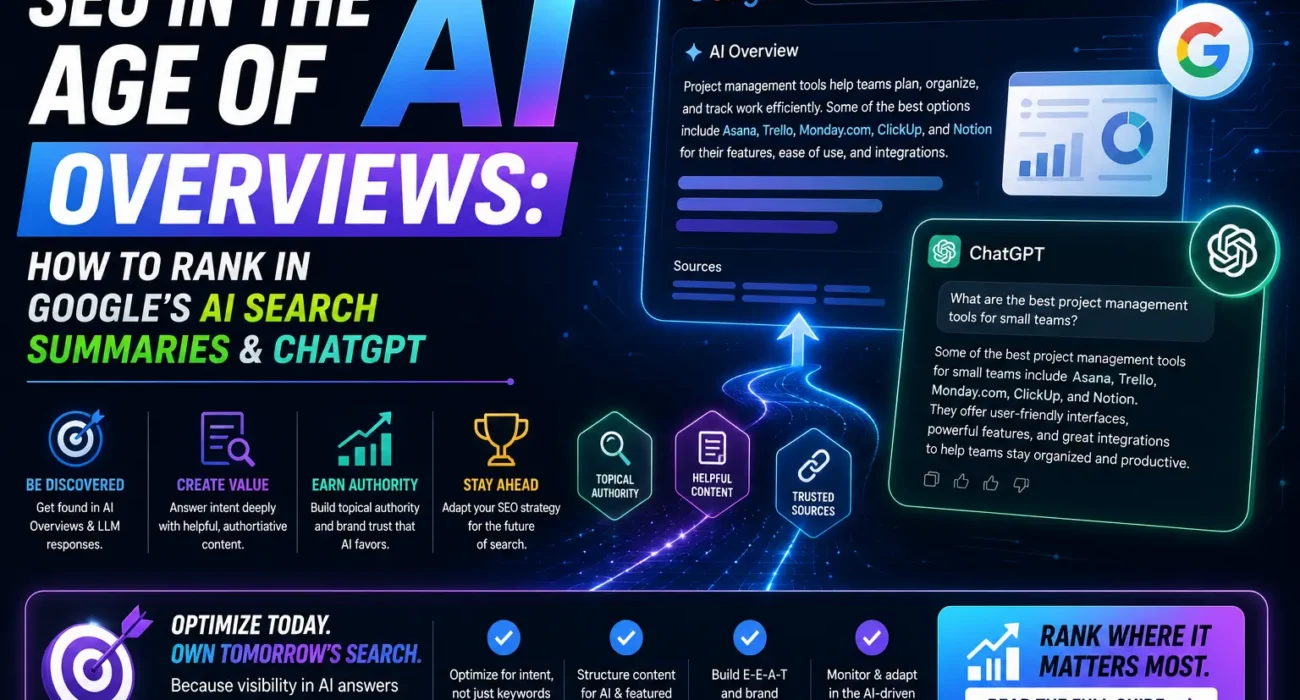
Mastering SEO in the age of AI Overviews is no longer optional for businesses trying to survive online. Search behavior has shifted permanently. When users type a question into Google today, they rarely look at ten blue links first. Instead, Google’s AI summary or SearchGPT generates a synthesized, direct response right at the top of the screen.
If your content isn’t cited in that initial summary, your organic visibility takes a massive hit. Data from recent 2026 industry studies shows that organic click-through rates drop by up to 61% when an AI Overview is present on the search results page. However, there is a massive silver lining. Brands that earn a direct citation inside an AI Overview see a 35% increase in organic clicks compared to traditional search positions.
To win in this new era, you need to adapt your strategy. Here is your comprehensive guide on how to rank in Google AI search summaries, optimize for LLM discovery, and leverage Generative Engine Optimization to stay ahead of the competition.
The New Reality: How Generative Search Is Changing Search Intent
Search engine algorithms used to focus primarily on matching exact keyword strings to web page tags. Today, Large Language Models (LLMs) use Retrieval-Augmented Generation (RAG) to understand the underlying context and entity relationships behind a search query.
When a user submits a complex question, the AI model breaks the prompt into multiple subtopics, retrieves passages from trusted indexed pages, and generates a cohesive response.
|
TRADITIONAL SEO vs. GEO |
|
| Traditional Organic Search | Generative Engine Optimization |
| Matches keyword strings to pages | Extracts semantic entities & RAG |
| Ranks individual URLs (1-10) | Synthesizes top 5-10 sources |
| Prioritizes backlink quantity | Prioritizes trust, recency & E-E-A-T |
| Focuses on broad CTR | Focuses on direct passage citation |
To rank in Google AI search summaries, your content must satisfy both human readers and machine parsers simultaneously.
Why Traditional Keyword Stuffing Fails
AI summaries do not care how many times you paste a keyword if your text lacks substance. LLMs evaluate semantic completeness. If your article skips crucial subtopics, the AI simply pulls missing facts from your competitor’s page instead.
When clients partner with a premier digital marketing agency like Binarquee, one of the first structural updates made is shifting from isolated keyword targeting to comprehensive entity mapping.
5 Core Strategies to Rank in Google AI Search Summaries and ChatGPT
Winning visibility inside AI summaries requires specific content formatting, technical authority, and entity-rich writing.
1. Implement Answer-First Formatting (Answer Engine Optimization)
AI models look for clear, definitive statements that answer specific questions. Every key H2 or H3 section in your article should begin with a direct 20 to 30-word answer block before diving into detailed explanations.
What is Generative Engine Optimization (GEO)?
Generative Engine Optimization (GEO) is the practice of optimizing digital content to increase its likelihood of being retrieved, cited, and summarized by AI search engines such as Google AI Overviews, ChatGPT, and Perplexity.
By placing this clear definition directly under the heading, you make it effortless for an AI crawler to extract your text as an authoritative source.
2. Strengthen E-E-A-T and Real-World Proof
Google’s Gemini and OpenAI’s search models heavily weigh Experience, Expertise, Authoritativeness, and Trustworthiness (E-E-A-T).
- Cite Primary Sources: Link directly to market reports, peer-reviewed studies, or official documentation.
- Include Proprietary Data: Original research, unique case studies, and first-hand operational insights receive preferential indexing in AI models.
- Author Credentials: Ensure every blog post features a verified author bio outlining industry experience.
3. Master Passage-Level Optimization and Structured Data
AI Overviews do not always cite entire pages; they extract specific passages. Structuring your content with clean header hierarchies (H2, H3, H4), bulleted lists, and detailed HTML tables allows LLMs to process complex information quickly.
Furthermore, implementing Schema.org markup (such as Article, FAQPage, and HowTo JSON-LD) provides explicit signals about your content’s structure.
4. Publish Fresh, High-Recency Content
Data shows that 53% of sources cited inside AI Overviews were updated within the previous six months. AI search engines prioritize accuracy and recency. Updating existing evergreen articles quarterly with updated statistics and fresh industry angles doubles your chances of maintaining citations.
5. Execute ChatGPT Search Optimization Beyond Your Own Domain
When optimizing for conversational search engines, ChatGPT search optimization requires a multi-platform presence. ChatGPT and Perplexity frequently pull recommendations from authoritative third-party platforms, industry directories, Reddit discussions, and high-tier news publications.
Building brand authority across external platforms signals to LLMs that your business is a recognized entity in your industry.
Market Data: The Statistics Shaping AI Search
Understanding search trends helps justify why evolving your marketing strategy is urgent:
- High AI Trigger Rates: Over 30% of U.S. desktop search queries now trigger an AI Overview, with informational queries exceeding 60% coverage.
- Citation Distribution: Approximately 86% of sources cited in Google AI Overviews come from pages that rank within the top 100 organic search results.
- Traffic Quality: Users clicking through from AI Overview citations show a 25% higher conversion intent because the AI has already pre-qualified their query.
How Binarquee Helps Brands Dominate AI Search
Navigating SEO in the age of AI Overviews requires technical precision, deep keyword research, and agile content production. As a full-service digital marketing agency, Binarquee specializes in helping businesses adapt to generative search environments.
Here is how Binarquee elevates your brand’s search visibility:
- AI Overview Audit: We analyze your existing content footprint to identify missing semantic entities and structural gaps preventing AI citation.
- Entity-Driven Content Engineering: Our team creates deeply researched, highly authoritative content designed explicitly for Generative Engine Optimization.
- Schema & Technical Infrastructure: We implement clean, error-free structured data so AI crawlers can effortlessly parse and verify your brand data.
- Omnichannel Brand Citations: We build your brand presence across external platforms, review sites, and industry hubs to ensure tools like ChatGPT recognize your business as a category leader.
Whether you need local visibility or global organic growth, partnering with an experienced digital marketing agency ensures your company stays visible while competitors lose traffic to zero-click searches.
Quick Insights: Navigating the Shift to AI Search
How does Generative Engine Optimization differ from traditional SEO?
Traditional SEO focuses on earning high positions on search engine result pages through backlinks and target keywords. Generative Engine Optimization focuses on structuring content so Large Language Models can easily extract, verify, and cite specific passages inside AI-generated summaries.
Why is ChatGPT search optimization critical for modern businesses?
ChatGPT search optimization ensures your brand is recommended when users ask conversational questions directly to AI assistants. As millions of users shift from standard search boxes to conversational AI tools, earning citations in LLM responses directly protects your brand awareness and customer acquisition funnel.
How can a digital marketing agency assist with AI search strategy?
A specialized digital marketing company provides the technical framework, semantic research, and content restructuring needed to rank in generative search engines. They ensure your website satisfies both traditional search engine crawlers and modern LLM indexing requirements.
Ready to Claim Your Space in AI Search Results?
The landscape of search engine optimization has transformed, but the goal remains the same: connecting with your ideal audience at the exact moment they need your expertise. Relying strictly on outdated keyword tactics will leave your business hidden behind AI answers.
By adopting Generative Engine Optimization and aligning your digital presence with how modern AI models evaluate trust, you can secure direct citations, drive qualified traffic, and outpace your competitors.
Need expert guidance to future-proof your search traffic? Contact a professional digital marketing company like Binarquee today to schedule a comprehensive AI search audit and discover how our tailored growth strategies can help your brand rank at the top of next-generation search engines.
Frequently Asked Questions (FAQs)
What is SEO in the age of AI Overviews?
SEO in the age of AI Overviews is the strategic practice of optimizing web content to secure source citations inside AI-generated search summaries on platforms like Google, ChatGPT, and Perplexity. It combines traditional organic ranking tactics with semantic depth, structured schema, and answer-first content formatting.
How do I rank in Google AI search summaries?
To rank in Google AI search summaries, optimize your content using concise answer blocks directly under H2 headers, include structured data schema, maintain strong domain E-E-A-T signals, update statistics regularly, and structure complex information using clear bullet points and comparison tables.
What is Binarquee?
Binarquee is a premier digital marketing agency providing specialized services in search engine optimization, Generative Engine Optimization, performance marketing, and conversion copywriting to help businesses scale their online presence.
How does Binarquee improve search rankings in AI Overviews?
Binarquee optimizes your content architecture, builds entity authority, implements advanced schema markup, and creates high-value, answer-ready content tailored to secure direct citations inside Google AI summaries and ChatGPT.
Does ChatGPT search use traditional Google rankings?
Not entirely. While ChatGPT Search relies on web indexing and real-time retrieval tools, its selection criteria heavily favor factual consensus, strong brand citations across trusted third-party sites, and clear, structured text over raw backlink metrics alone.
Can local businesses rank in Google AI search summaries?
Yes. Local AI Overviews frequently pull business details, reviews, and service descriptions from structured directory listings, localized landing pages, and Google Business Profiles. Structuring clear local service descriptions helps AI engines recommend local businesses directly.