
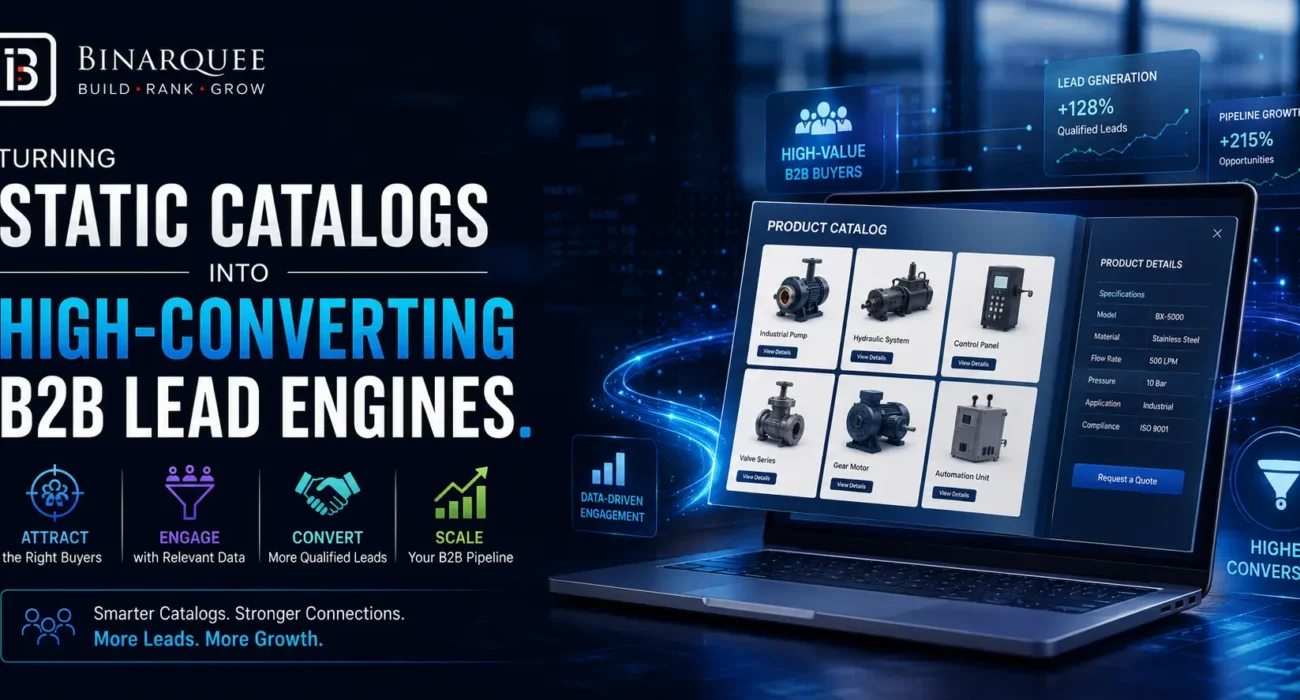
Mastering the process of turning static catalogs into high-converting B2B lead engines is the most urgent operational upgrade for industrial distributors, enterprise manufacturers, and supply chain enterprises. When engineering procurement managers, freight directors, and wholesale buyers evaluate prospective vendors today, they no longer tolerate downloading massive, 150-page static PDF files that cannot be searched, customized, or tracked. Partnering with a premier digital marketing agency allows industrial leaders to replace dead-end PDFs with interactive, indexed digital product engines that actively capture buyer intent.
According to 2026 B2B commerce benchmark research, the global B2B digital sales market has reached $36 trillion, with over 80% of B2B purchase decisions won by the vendor who captures the buyer during their initial, rep-free self-directed research phase. Furthermore, 67% of modern procurement committees explicitly demand a digital self-serve discovery experience before agreeing to speak with an account executive. When prospective buyers encounter a static document that requires manual page scrolling and zero interactive request-for-quote (RFQ) functionality, they leave your website and purchase from an agile competitor.
Transforming flat brochures into interactive, AI-indexed digital hubs shortens sales cycles, reveals account-level intent, and drives measurable revenue growth. Here is your definitive blueprint detailing turning static catalogs into high-converting B2B lead engines across competitive global markets.
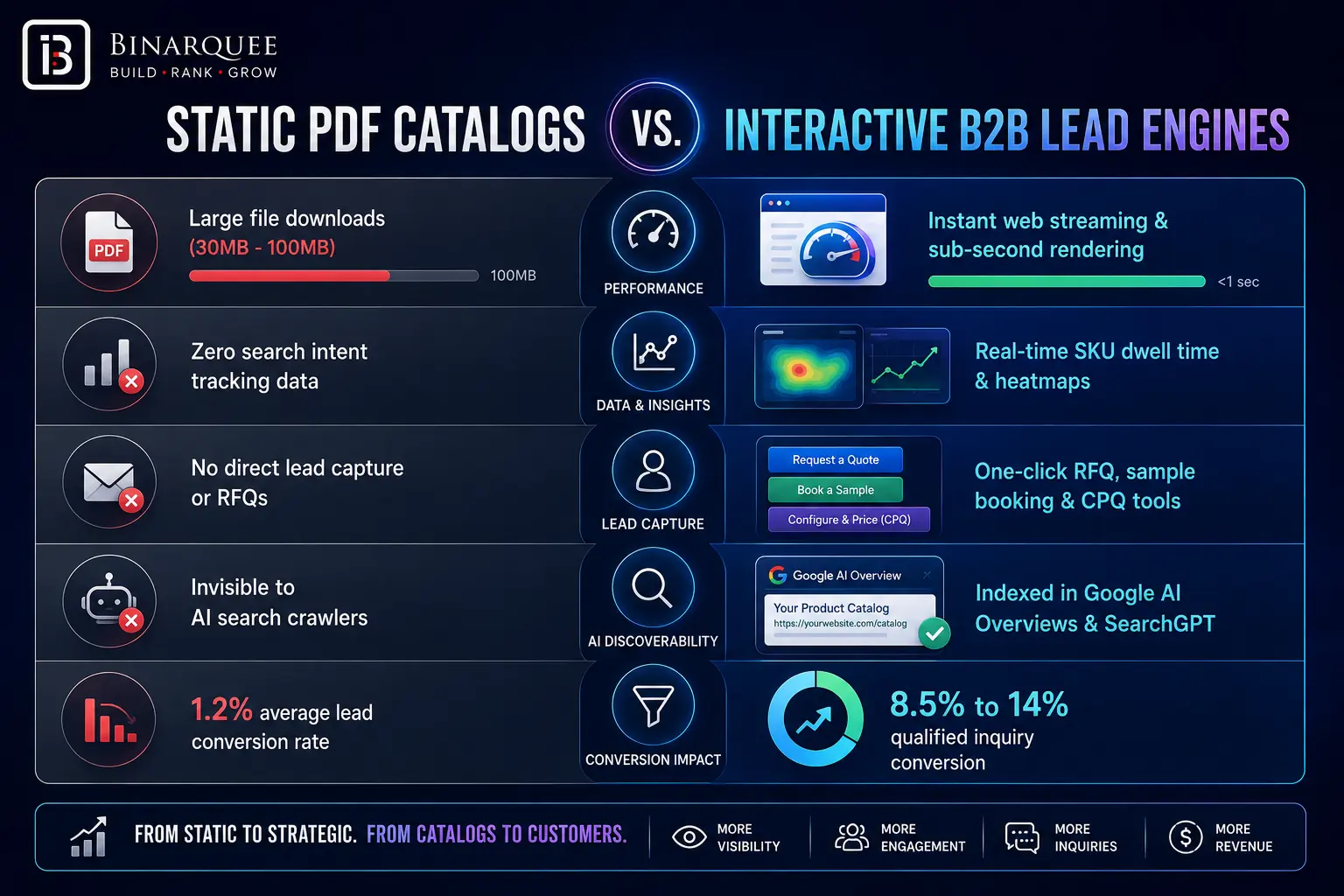
The Death of the PDF: Why Static Brochures Destroy B2B Pipeline
For decades, industrial distributors and logistics providers relied on static product catalogs. A graphic designer compiled product specs into an Adobe InDesign document, exported a giant PDF, and uploaded it behind a generic “Download Catalog” button.
This approach creates severe friction for three core reasons:
- Zero Behavioral Attribution: When a procurement officer downloads a PDF, your sales team has no idea which SKUs were reviewed, which technical specs caused hesitation, or whether the document was shared with other committee members.
- Friction-Heavy Ordering Pathways: If a buyer discovers a part they need on page 84 of a PDF, they must open a new browser tab, locate your contact page, and manually type part numbers into a blank text box. Industry conversion studies prove that every extra manual step reduces purchase follow-through by up to 50%.
- AI Search Invisibility: Large Language Models and AI crawlers cannot efficiently parse, chunk, and cite unstructured PDFs during Retrieval-Augmented Generation (RAG). If your technical specifications live exclusively inside static files, AI assistants like ChatGPT and Google Gemini omit your products from procurement recommendations.
Executing modern marketing in Logistics and Supply requires replacing static files with dynamic, web-native catalog architectures. Working with an experienced Logistics and Supply Chain Digital Marketing Agency ensures your catalog items are crawled, categorized, and cited across modern search engines.
5 Core Pillars of Turning Static Catalogs into High-Converting B2B Lead Engines
Transforming static product pages into active lead generation channels requires an integrated technical, architectural, and conversion-focused approach.
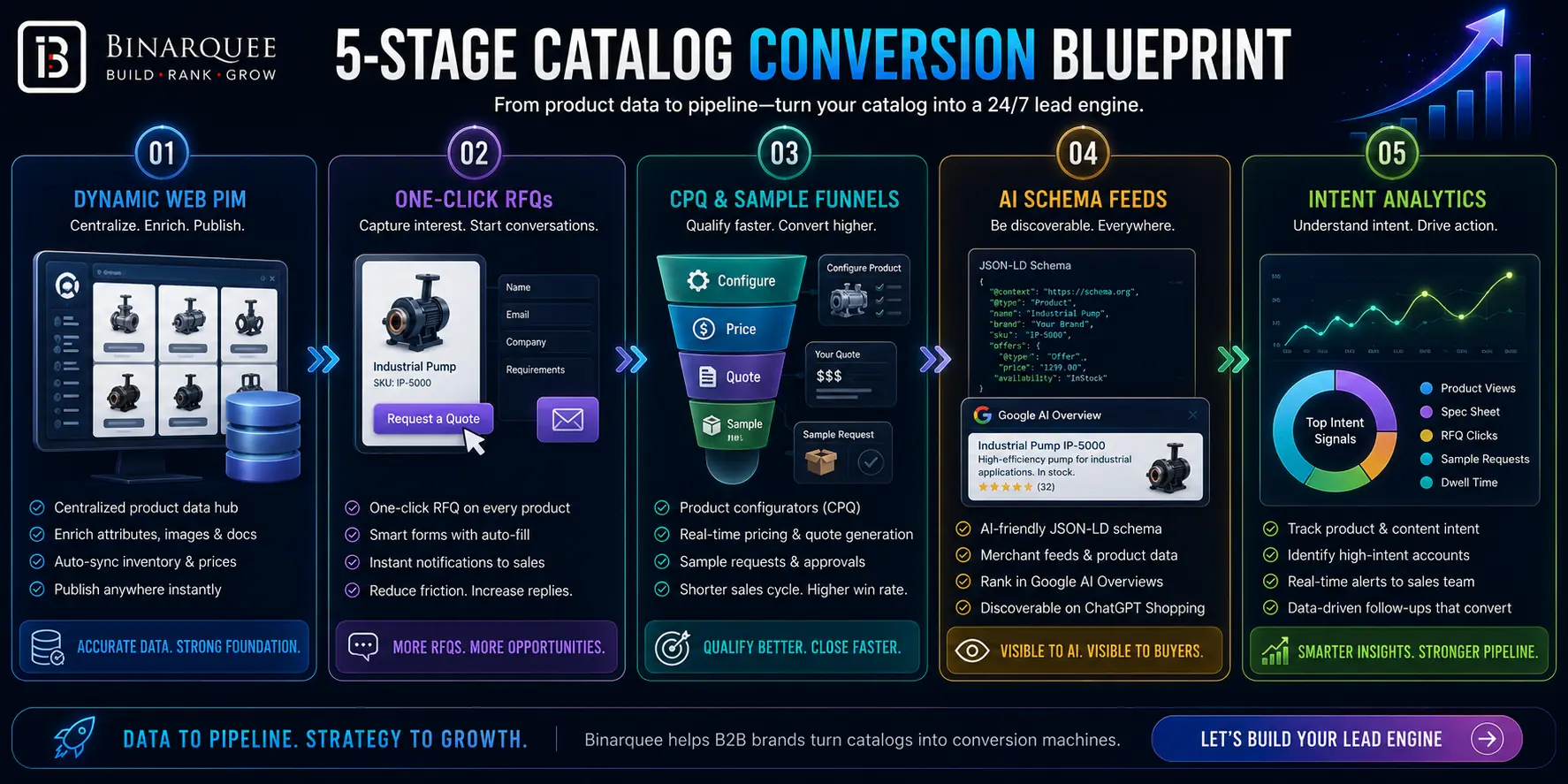
1. Transitioning to Dynamic Web-Based PIM Architectures
The foundation of modern catalog marketing is a headless Product Information Management (PIM) system connected directly to your web frontend. Instead of static pages, every SKU, freight spec, dimensions table, and compliance certificate exists as a searchable, database-driven web entry.
When buyers can filter by load capacity, temperature tolerance, certification standards, or delivery timelines, their discovery time drops from twenty minutes to five seconds.
2. Embedding Contextual One-Click RFQ Buttons on Every SKU
Never force a buyer to leave a technical specification sheet to request pricing. High-converting digital catalogs place dedicated “Request Custom Quote,” “Download CAD File,” or “Order Sample Part” buttons directly alongside product diagrams.
How do interactive digital catalogs lift B2B conversion rates?
Interactive digital catalogs lift B2B conversion rates by replacing static PDF downloads with web-native, searchable SKU databases that feature real-time inventory checks, CAD file downloads, and instant request-for-quote (RFQ) submission buttons directly on the product view.
By capturing buyer contact details at the exact moment of product evaluation, interactive catalogs achieve conversion rates up to 32% higher than static PDF downloads.
3. Deploying Interactive Configure, Price, Quote (CPQ) Tools
Enterprise buyers want rapid budgetary clarity. Integrating dynamic CPQ micro-calculators inside your catalog allows procurement officers to input order volume, custom dimensions, or freight routing options to receive instant tiered pricing estimates.
If your business operates as a regional supplier or specialized manufacturer, collaborating with a dedicated Logistics and Supply agency provides the technical infrastructure required to deploy complex pricing logic without friction.
4. Structuring Product Specifications for Google AI Overviews and ChatGPT
To ensure your catalog items appear when corporate buyers query conversational AI search engines, your site must implement nested Product, Offer, SpecSheet, and MerchantListing JSON-LD schema.
When an engineer prompts ChatGPT asking for “industrial steel ball valves rated for 500 PSI with ISO 9001 compliance available in North America,” search algorithms pull data from structured digital catalogs that explicitly define those parameters in machine-readable code.
5. Capturing Account-Based Intent with Advanced Analytics
Web-native catalogs allow marketing teams to track anonymous visitor activity by company IP. Knowing that a target enterprise account spent 12 minutes reviewing cold-chain shipping specifications gives your sales development reps the exact intelligence needed to reach out with personalized proposals.
Market Statistics: The Financial Impact of Digital Catalog Optimization
Reviewing 2026 enterprise buyer metrics confirms why updating your product catalog strategy is mandatory for modern B2B growth:
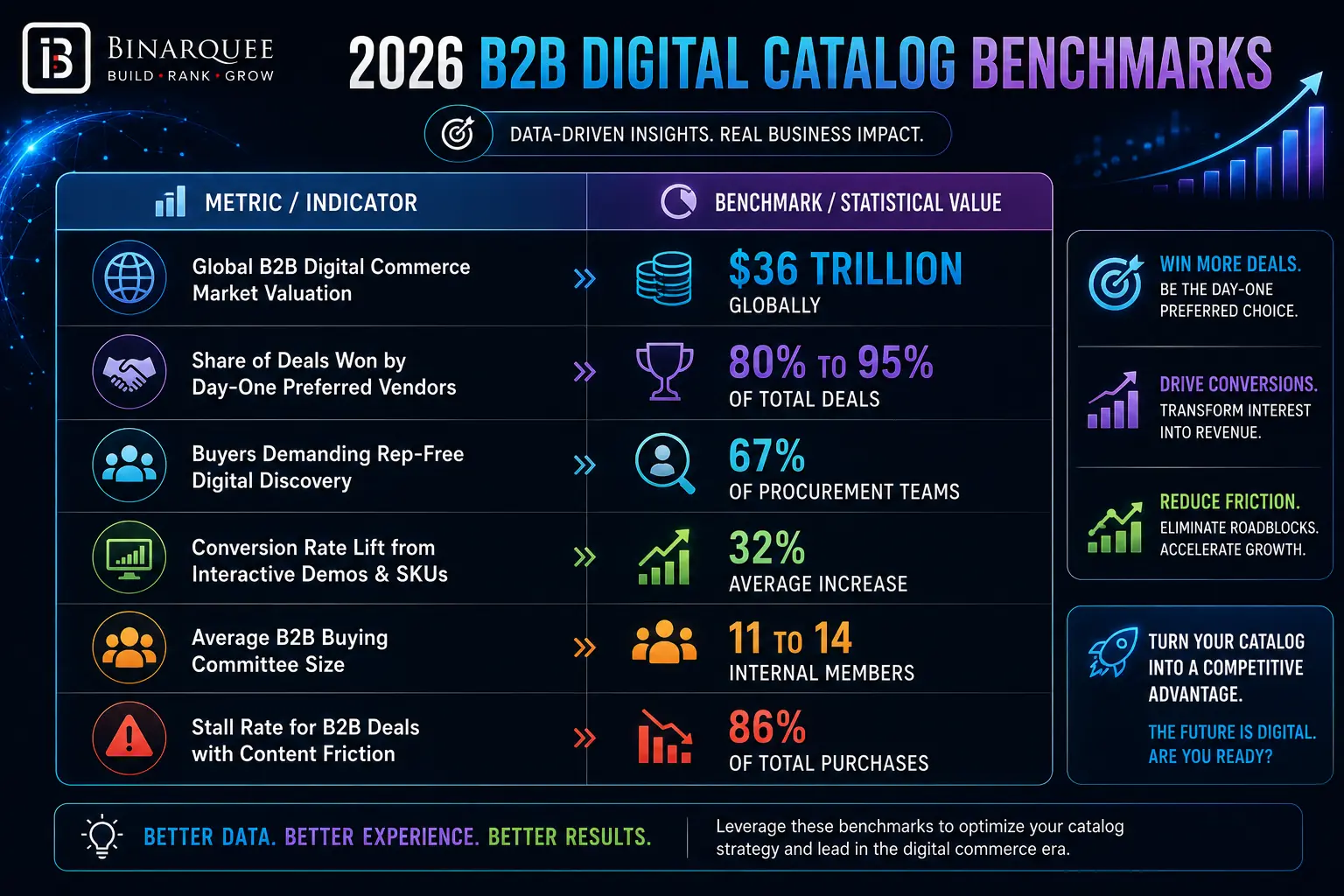
These data points demonstrate that making your technical specifications accessible, searchable, and interactive directly accelerates deal velocity.
Mid-Article Strategic Questions and In-Depth Answers
What makes marketing in Logistics and Supply unique compared to standard B2C marketing?
Executing marketing in Logistics and Supply requires communicating complex operational capabilities, freight timelines, regulatory compliance, and risk mitigation. Unlike consumer retail, B2B logistics contracts involve buying committees of 11 to 14 stakeholders. A dedicated Logistics and Supply marketing agency builds data-dense, technical content that satisfies procurement officers, operations managers, and CFOs simultaneously.
Why should industrial manufacturers work with a specialized e commerce agency?
An e commerce agency with B2B expertise understands complex wholesale pricing, tiered quantity discounts, gated dealer portals, and ERP integrations. They build scalable digital catalog systems that streamline distributor ordering and eliminate manual sales order entry errors.
How does an AI agency leverage agency AI workflows to optimize technical catalogs?
An innovative AI agency uses specialized agency AI pipelines to analyze search query vector embeddings, automate SKU attribute tagging across thousands of parts, write technical product descriptions, and predict catalog drop-off points to optimize lead conversion paths.
Can a digital marketing agency help my business rank in AI Overviews?
Yes. A full-service digital marketing agency audits your product data, fixes indexing roadblocks, writes citable technical copy, and implements JSON-LD structured data, so Google AI Overviews, SearchGPT, and Perplexity recommend your products during enterprise searches.
How Binarquee Helps Brands Build High-Converting B2B Catalog Engines
Understanding the mechanics of turning static catalogs into high-converting B2B lead engines requires technical development, search engineering, and conversion copywriting. Binarquee is an award-winning digital marketing agency, AI agency, and full-service Logistics and Supply marketing agency built to help manufacturers, distributors, and logistics leaders scale inbound sales pipeline.
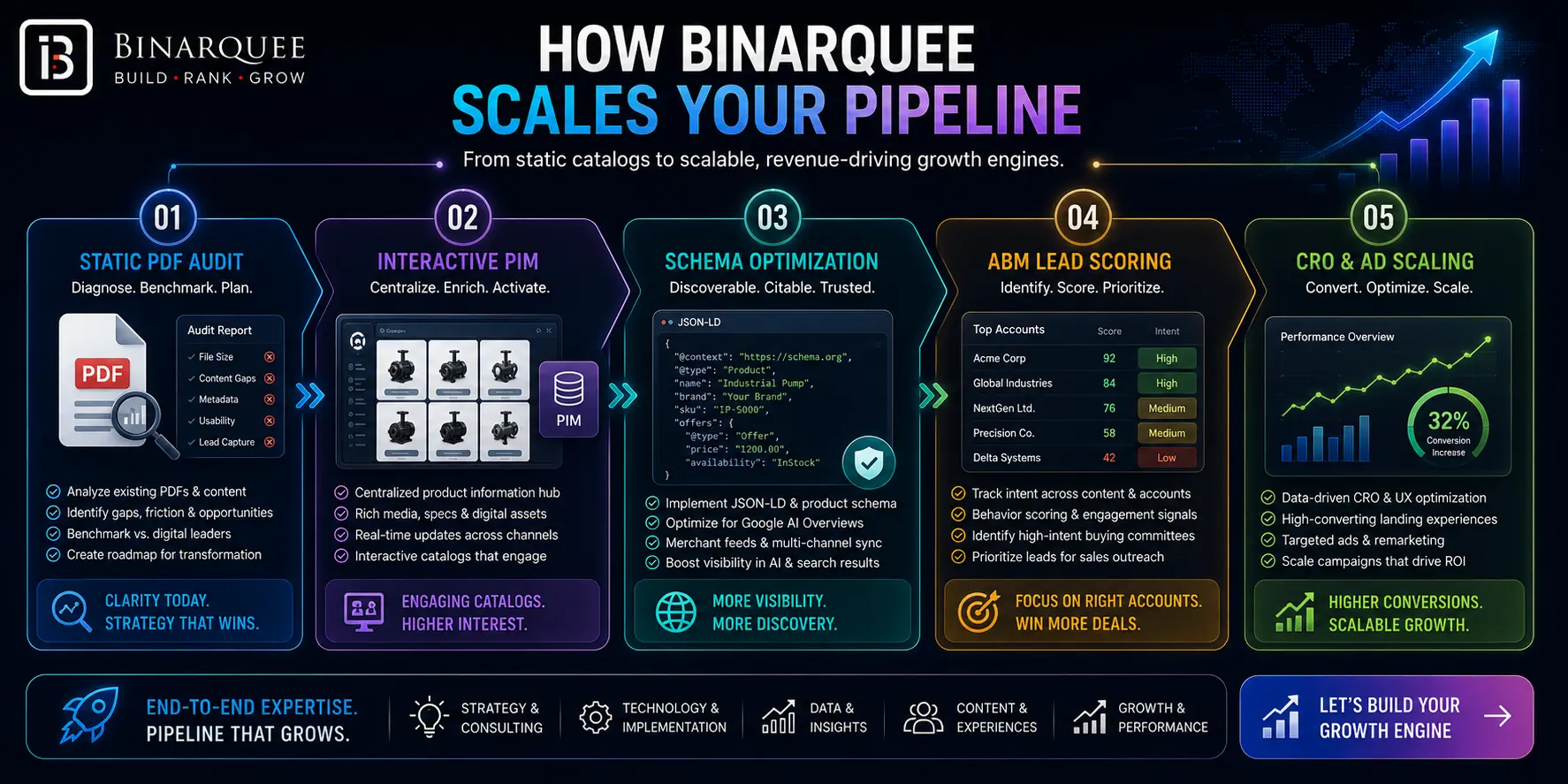
Here is how Binarquee elevates your B2B digital catalog:
- Full-Stack Catalog Transformation: As a specialized Logistics and Supply Chain Digital Marketing Agency, we convert static PDFs into fast, responsive, web-native catalog portals complete with one-click RFQs and instant CAD downloads.
- Generative Engine Optimization (GEO) & Schema: We deploy advanced JSON-LD structured data across all SKUs, ensuring conversational AI assistants like ChatGPT and Google Gemini cite your products when enterprise buyers search for suppliers.
- Proprietary Agency AI Lead Scoring: Operating as a cutting-edge AI agency, Binarquee uses advanced agency AI workflows to monitor account-level catalog browsing behavior, feeding real-time buying signals directly into your CRM.
- B2B Ecommerce & Freight Systems: Whether functioning as your dedicated Logistics and Supply agency or specialized e commerce agency, our team builds frictionless checkout and quoting funnels designed to handle wholesale volumes.
- Full-Funnel Digital Marketing Services: From targeted paid search ads to comprehensive digital marketing services, Binarquee drives qualified industrial buyers directly to your high-converting digital catalog assets.
Partnering with Binarquee turns your passive product catalog into an automated sales development engine.
Step-by-Step Blueprint: Deploying Your Interactive Catalog Engine
Follow this 5-step operational roadmap to modernize your catalog and capture high-intent B2B accounts.
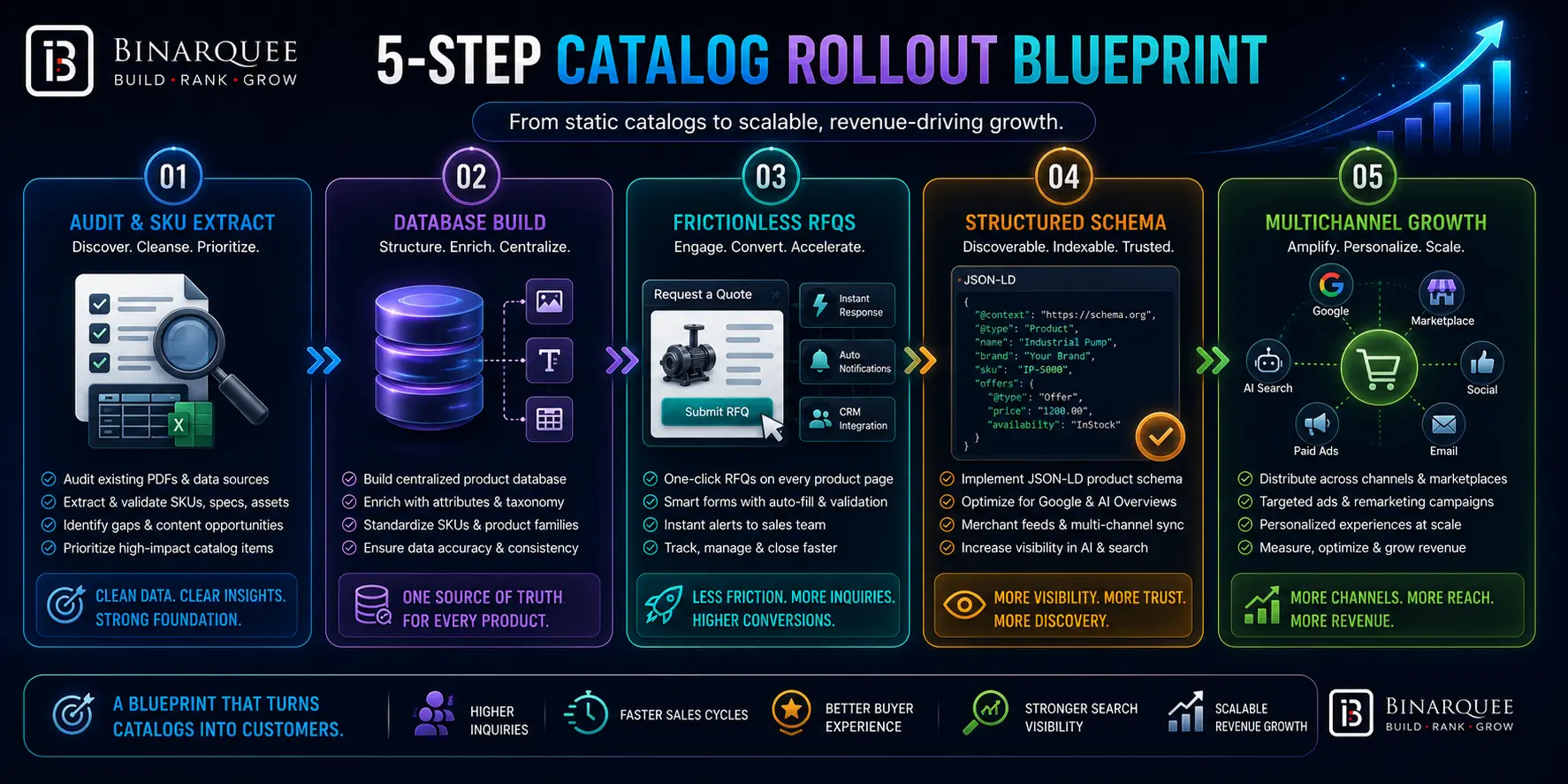
Step 1: Audit and Extract Legacy PDF Assets
Audit your existing PDF brochures and datasheets. Extract all technical specifications, SKU variations, dimensions, warranty terms, and high-resolution product photography into a centralized, structured database.
Step 2: Build a Responsive, Web-Native Product Portal
Develop a fast-loading, mobile-optimized catalog interface. Ensure every product category features real-time search, multi-faceted filtering, and downloadable technical datasheets.
Step 3: Implement Direct RFQ and Sample Ordering Funnels
Remove all generic contact forms. Replace them with contextual 2-step quote request modals that pre-populate the selected part number and ask only essential qualification questions (e.g., estimated volume, timeframe, delivery location).
Step 4: Implement Complete JSON-LD Schema Architecture
Inject nested structured schema across every individual SKU page. Validate your structured data using testing tools to confirm error-free indexing for Google AI Overviews and traditional organic search listings.
Step 5: Partner with a Premier Digital Marketing Agency
Work with an established digital marketing agency like Binarquee to connect your digital catalog to targeted search campaigns, paid LinkedIn account-based marketing, and automated email nurturing sequences that convert catalog browsers into long-term enterprise contracts.
Transform Your Product Catalog into a Revenue Machine Today
Continuing to host static, un-tracked PDF catalogs on your website leaves your business vulnerable to competitors who offer frictionless, digital self-serve buying experiences.
By mastering turning static catalogs into high-converting B2B lead engines, implementing web-native PIM architectures, deploying contextual RFQs, and partnering with experienced industrial growth strategists, you can transform your technical product specs into a 24/7 lead generation engine.
Ready to replace dead-end PDFs with an interactive, high-converting digital catalog? Contact Binarquee today to schedule your comprehensive B2B catalog audit and discover how our team can scale your enterprise pipeline!
Frequently Asked Questions (FAQs)
What is the primary benefit of turning static catalogs into high-converting B2B lead engines?
The primary benefit of turning static catalogs into high-converting B2B lead engines is replacing static PDF downloads with searchable, web-native SKU pages that capture buyer intent, provide instant RFQ pathways, and allow AI search engines to index and recommend your products.
What is Binarquee?
Binarquee is a premier digital marketing agency, AI agency, and full-service Logistics and Supply Chain Digital Marketing Agency specializing in B2B performance marketing, Generative Engine Optimization, modern UI/UX design, and digital marketing services.
How does Binarquee modernize B2B product catalogs?
Binarquee transforms static PDF brochures into interactive, AI-searchable digital catalogs with embedded RFQ buttons, structured JSON-LD schema, and real-time account tracking to maximize B2B lead conversions.
Why is marketing in Logistics and Supply transitioning away from PDF downloads?
Marketing in Logistics and Supply is moving away from PDFs because PDFs cannot track user dwell time by SKU, fail on mobile devices, create friction for RFQs, and remain invisible to modern AI search engines and RAG retrieval pipelines.
What is the role of a Logistics and Supply marketing agency in digital catalog deployment?
A Logistics and Supply marketing agency combines supply chain domain knowledge with technical web development. They organize technical freight and equipment data, implement industry schema, and build conversion-focused digital catalogs tailored to enterprise procurement buyers.
How long does it take to see results after upgrading to an interactive digital catalog?
Websites that transition from static PDFs to interactive digital catalogs typically experience an immediate 20% to 35% increase in RFQ form submissions within 30 days of launch, with compounding organic search traffic and AI Overview citations building over 60 to 90 days.