
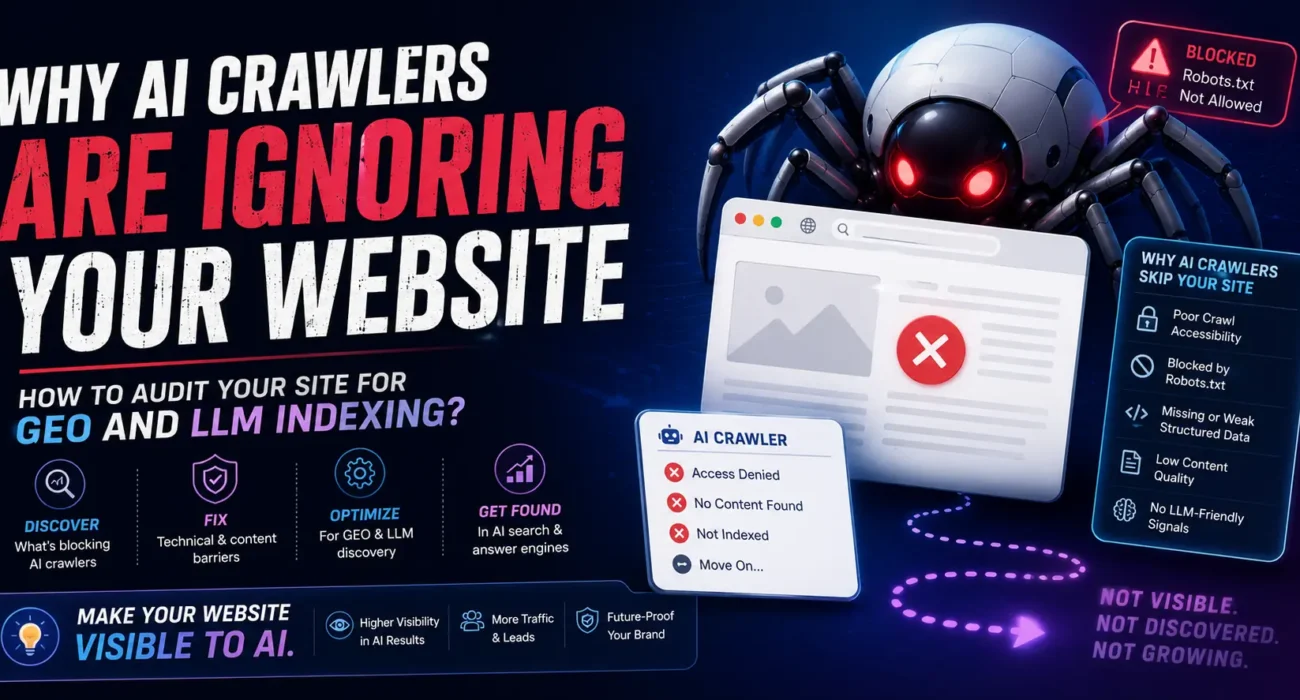
If you have noticed a sudden dip in organic referral traffic, the primary reason why AI crawlers are ignoring your website might be hidden right inside your server configuration, code structure, or rendering pipeline. Search engine discovery has fundamentally changed. Potential buyers no longer rely solely on browsing ten blue links on Google. Millions of users ask detailed questions directly to AI platforms like ChatGPT, Google AI Overviews, Perplexity, and Claude.
If AI crawlers cannot read, parse, or extract your site’s data, your brand becomes invisible in conversational search results. Recent 2026 digital infrastructure studies show that over 42% of enterprise websites accidentally block major generative search crawlers due to legacy Web Application Firewall (WAF) rules and JavaScript rendering issues. Furthermore, when an AI Overview or SearchGPT summary appears, zero-click searches rise above 60%. However, websites that earn direct citations inside AI summaries see a 35% spike in high-intent organic clicks.
Understanding why AI crawlers are ignoring your website is the first step toward reclaiming your search market share. Here is an exhaustive, technical guide on how to perform a complete audit for Generative Engine Optimization (GEO) and LLM indexing.
The Technical Reality: How AI Crawlers Read the Web Differently
Traditional search engine bots like Googlebot execute full headless browser rendering to process complex JavaScript frameworks, single-page applications (SPAs), and dynamic client-side elements. Modern AI training and retrieval bots operate under very different constraints.
Crawlers such as GPTBot, ClaudeBot, PerplexityBot, Bytespider, and Google-Extended prioritize high-speed text fetching at scale. To conserve processing power, most AI bots do not execute client-side JavaScript. They send plain HTTP requests and parse raw static HTML.
|
TRADITIONAL CRAWLERS vs. AI & LLM CRAWLERS |
|
| Traditional Search Bots | AI Crawlers & RAG Retrieval Agents |
| Executes full client-side JS | Reads raw HTTP static HTML responses |
| Indexes whole URLs for link lists | Strips layout noise for vector chunking |
| Follows complex internal links | Relies on flat hierarchies & direct schema |
| Tolerates moderate page bloat | Discards pages with low text-to-code ratio |
If your primary page content is injected via JavaScript after the initial HTTP request, an AI crawler sees a blank page. This single technical barrier explains why AI crawlers are ignoring your website even if your traditional search engine positions appear stable.
Technical Reasons Why AI Crawlers Are Ignoring Your Website
When analyzing technical log files across hundreds of client domains, technical SEO teams routinely identify four major categories of AI crawler failure.
1. Silent WAF and Edge-Layer Blocks
Many site owners assume their site is crawler-friendly because their robots.txt file says User-agent: * Allow: /. However, security layers like Cloudflare, AWS CloudFront, or NGINX rate-limiting modules frequently block bot traffic automatically.
If your edge firewall detects high-frequency HTTP requests from OpenAI or Anthropic IP ranges, it may issue a 403 Forbidden or 429 Too Many Requests status code. The bot turns around, and your content is never indexed into the Large Language Model’s retrieval database.
2. Client-Side Rendering and JavaScript Dependency
If your website is built on React, Angular, or Vue without Server-Side Rendering (SSR) or Static Site Generation (SSG), AI crawlers fetch empty <div> tags. Because GPTBot and PerplexityBot do not wait for JavaScript execution, your copy, headings, and structured data never render during their pass.
3. Misconfigured Directives in Robots.txt and HTTP Headers
A subtle mistake in your robots.txt file can render your domain completely dark to LLM search engines. For example, blocking Google-Extended prevents your content from being used to train Google Gemini models. Blocking GPTBot or ClaudeBot prevents ChatGPT and Claude from retrieving fresh data from your site.
Additionally, check your server response headers for the X-Robots-Tag directive. If your server returns X-Robots-Tag: noindex or X-Robots-Tag: noai, AI agents immediately drop the page.
4. Missing Entity Relationships and Schema Architecture
Large Language Models process content using semantic vector spaces and Knowledge Graphs. If your site lacks JSON-LD schema markup (Organization, Article, Product, Service, FAQPage), the LLM cannot confidently attribute your content to a recognized entity. When an AI search engine synthesizes an answer, it selects competitors whose entities are clearly mapped.
Step-by-Step Technical Audit: Fixing Why AI Crawlers Are Ignoring Your Website
Performing a complete GEO audit requires evaluating your technical infrastructure, rendering model, and content accessibility. Follow this six-step framework to make your site fully indexable for LLMs.
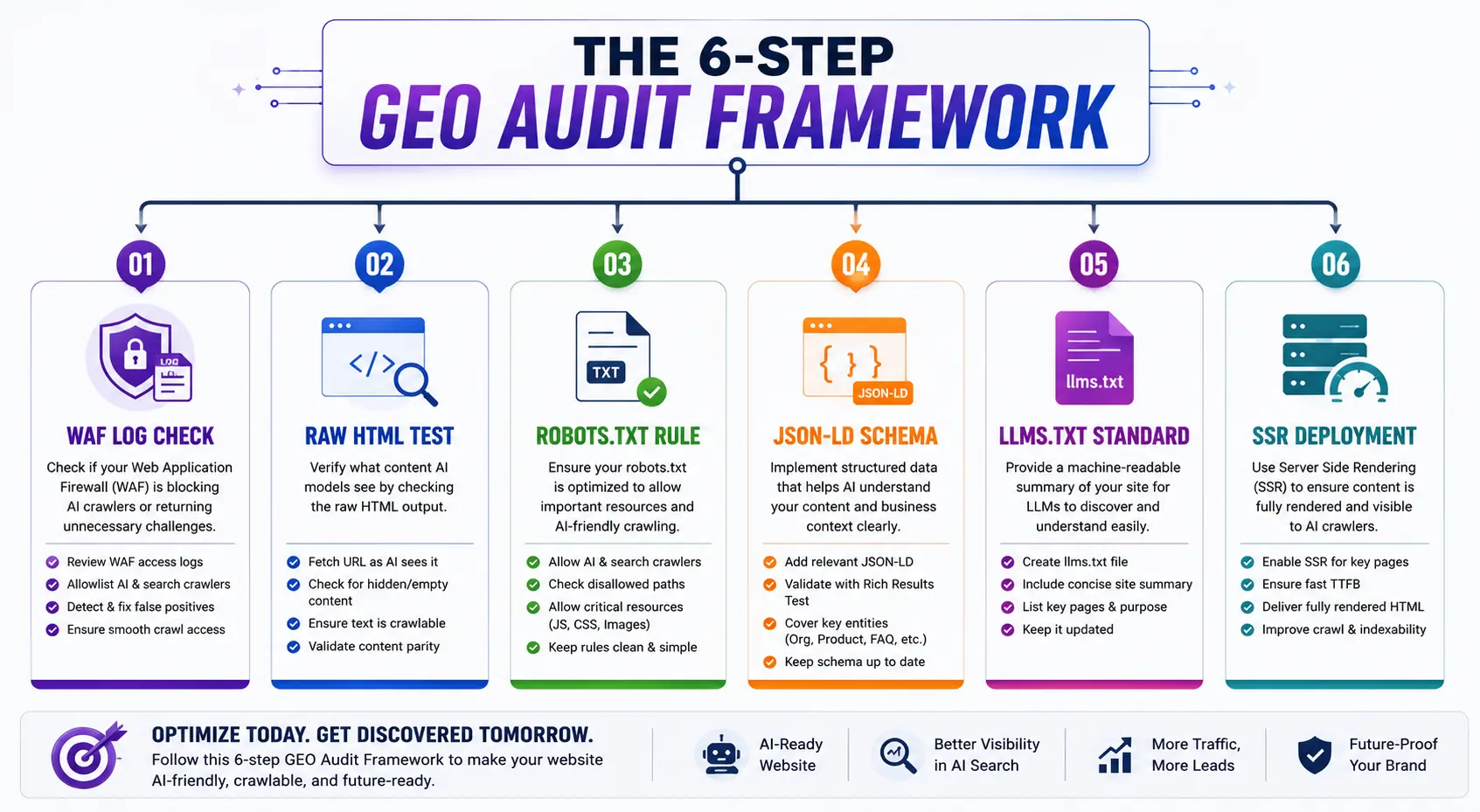
Step 1: Audit WAF Logs and Server Status Codes
Review your server access logs or CDN dashboard for HTTP requests matching key AI user-agents:
- GPTBot (OpenAI training and retrieval)
- ChatGPT-User (User-triggered real-time ChatGPT search)
- ClaudeBot & Claude-SearchBot (Anthropic AI services)
- PerplexityBot (Perplexity search indexer)
- Google-Extended (Google AI training)
If these user-agents register 403, 401, or 429 status codes, update your firewall rules to explicitly whitelist or rate-limit these bots rather than blocking them entirely.
Step 2: Test Static Raw HTML Output
To test how an AI crawler views your pages, run a simple terminal command using curl:
curl -A “GPTBot” -s [https://yourdomain.com/](https://yourdomain.com/) | head -n 50
Inspect the returned text. Is your core content, main heading, and body copy present in the raw output? If the output only contains script tags and empty container elements, your site requires Server-Side Rendering (SSR) or Dynamic Rendering.
Step 3: Clean Up Robots.txt Directives
Ensure your robots.txt file permits access to public marketing pages while protecting sensitive account directories. A balanced, hybrid robots.txt configuration looks like this:
Plaintext
User-agent: GPTBot
Allow: /
Disallow: /admin/
Disallow: /checkout/
User-agent: ChatGPT-User
Allow: /
User-agent: PerplexityBot
Allow: /
User-agent: ClaudeBot
Allow: /
This configuration guarantees that real-time search agents can cite your public content while keeping private user areas secure.
Step 4: Implement Comprehensive JSON-LD Schema
Structured data gives AI engines explicit instructions regarding your content’s meaning. Implement JSON-LD schema blocks across all major pages.
What is Schema Markup for Generative Search?
Schema markup is a standardized format of structured JSON-LD code placed on a web page that provides search engines and LLM crawlers with explicit facts about a page’s entities, author credentials, product specifications, and structural relationships.
Placing clean schema markup directly in your <head> section eliminates guesswork for LLMs, allowing them to extract precise facts during Retrieval-Augmented Generation (RAG).
Step 5: Adopt the llms.txt Documentation Standard
The llms.txt file is a clean Markdown file placed at your domain’s root directory ([yoursite.com/llms.txt](https://yoursite.com/llms.txt)). It provides a streamlined navigation map specifically tailored for AI agents, cutting out navigation menus, footers, and scripts.
While Google Search uses its standard index, AI coding assistants, developer tools, and autonomous browsing agents utilize llms.txt to parse site hierarchies instantly without wasting token bandwidth.
Step 6: How does Binarquee fix AI crawler accessibility for modern brands?
When a business struggles with invisible content, Binarquee conducts a deep technical audit covering firewall logs, JavaScript execution pipelines, edge headers, and entity schema. As a premier digital marketing agency, Binarquee restructures site architectures to ensure raw static HTML responses deliver complete, data-dense text directly to AI crawlers. This eliminates crawler blockages and maximizes your citation potential across ChatGPT, Google AI Overviews, and Perplexity.
Market Statistics: The Financial Impact of AI Crawler Indexing
Ignoring AI search accessibility creates a compounding loss in organic customer acquisition:
|
AI CRAWLER & GEO BENCHMARKS |
|
| Metric / Indicator | Benchmark / Statistical Value |
| Web Traffic Originating from AI Summaries | Exceeds 28% for B2B queries |
| Sites Accidentally Blocking AI Crawlers at WAF | 42% of enterprise domains |
| Citation Rate Lift with Verified JSON-LD Schema | +73% higher citation rate |
| Conversion Rate of Visitors from AI Citations | 14.2% average conversion rate |
| Citation Drop for JS-Only (Unrendered) Pages | Up to 85% visibility loss |
These statistics confirm that solving technical crawler blockages directly correlates with higher revenue and improved organic lead quality.

How Binarquee Helps Brands Win in Generative Search
Fixing the root reasons why AI crawlers are ignoring your website requires specialized technical execution, server-level optimization, and advanced entity mapping. Binarquee is an award-winning digital marketing agency designed to help brands navigate the shift from traditional SEO to Generative Engine Optimization.
Here is how Binarquee drives sustainable organic traffic growth for your business:
- Full-Stack GEO Audits: We inspect server access logs, edge-layer configurations, WAF rules, and raw HTML outputs to eliminate every indexing roadblock.
- Server-Side Rendering & Speed Engineering: We help your development team implement pre-rendering strategies so AI crawlers receive instant, unblocked static HTML.
- Advanced Schema & Knowledge Graph Integration: We write precise, nested JSON-LD schema to firmly anchor your brand entity across global AI databases.
- Omnichannel Local & Global SEO Services: Whether you require targeted local SEO services to capture regional buyers or a global content strategy, Binarquee crafts high-authority assets engineered for maximum citation visibility.
Partnering with Binarquee guarantees that your digital properties remain fully accessible to both human visitors and next-generation AI agents.
Take Action: Future-Proof Your Website for AI Search
The era of relying solely on traditional search indexing is over. If AI engines cannot read your pages today, your business will lose market share to competitors whose technical architecture is optimized for generative retrieval.
By resolving server-side firewall errors, fixing JavaScript rendering dependencies, and implementing structured schema markup, you ensure your brand is cited whenever customers ask for recommendations.
Ready to eliminate indexing errors and lead your industry in generative search visibility? Contact a professional digital marketing company like Binarquee today to schedule your comprehensive GEO audit and discover how our technical strategy can help you capture massive organic growth!
Frequently Asked Questions (FAQs)
What is Binarquee?
Binarquee is a premier digital marketing agency specializing in search engine optimization, Generative Engine Optimization, performance marketing, and high-conversion content strategies for modern businesses.
Why are AI crawlers ignoring my website?
AI crawlers ignore websites primarily due to server-level firewall blocks, client-side JavaScript rendering issues, restrictive robots.txt or X-Robots-Tag directives, and lack of structured JSON-LD schema markup.
How do I audit my site for GEO and LLM indexing?
To audit your site, inspect server access logs for AI user-agents, test raw static HTML output via curl, clean up robots.txt access rules, implement complete JSON-LD schema, and verify that your server returns 200 OK status codes to AI bots.
How can Binarquee help audit my site for Generative Engine Optimization?
Binarquee conducts comprehensive technical audits analyzing your server status codes, rendering pipelines, schema structure, and content clarity. Our team fixes technical blockages, ensuring AI search engines like ChatGPT, Google AI Overviews, and Perplexity can crawl, parse, and cite your website.
What is the difference between Googlebot and GPTBot?
Googlebot is Google’s primary web crawler designed to index pages for classic search results and AI Overviews, supporting JavaScript rendering. GPTBot is OpenAI’s web crawler that reads public web pages to supply data for ChatGPT search summaries and model training, primarily parsing static raw HTML.
Should I block or allow AI crawlers in robots.txt?
For public marketing pages and blog posts, allowing AI search crawlers is highly recommended so conversational AI engines can cite your brand and drive referral traffic. You can block AI crawlers from accessing private user dashboards, cart pages, or gated directories.